Placement
Where to mount an EV charger
The charger goes where the cable can reach the port with the car parked the way you actually park it. Everything else on this page is a refinement of that.
By Sawyer V. · Published September 23, 2026

How this page is funded: we earn a commission if you buy through our Amazon links, at no extra cost to you. It does not change what we recommend, and we say plainly when the honest answer is to buy nothing. Full disclosure.
Mounting position is decided once and lived with for years. It is also the cheapest thing to get right, because moving a charger later means moving a circuit. Follow the order below and the answer usually chooses itself.
1. Where is the charge port?
Ports differ by manufacturer: front fender, rear quarter, sometimes the nose. Stand where the car parks and look. Then ask the awkward question -- does the car always park that way round? A charger sited for nose-in parking can be useless the week you start backing in.
If two cars will share the charger, site it for the harder one and check the easier one still reaches.
2. Measure the real path
Why the straight line lies
Mounted at chest height, the cable falls to the ground first: 3 to 4 ft
Then it travels along the floor to the car: the map distance
Then it rises to the port: another 2 to 3 ft
Then add slack so the connector is not under tension
A 12 ft straight line is comfortably a 20 ft cable path
Cables run from 16 to 25 ft on the units covered here. Cable length has the measuring method, and long-cable chargers the units at the top of that range.
3. Which wall
| Position | Good | Watch for |
|---|---|---|
| Side wall beside the parking bay | Short cable path, out of the way | Door swing and wall clutter |
| Back wall of the garage | Central, reaches both bays | Bumper clearance, shelving |
| Wall shared with the panel | Cheapest circuit | May be the far side from the port |
| Outside wall, driveway | No garage needed | Needs an outdoor-rated unit and weather thought |
| Detached garage | Charger where the car is | A feeder run, and possibly a subpanel |
4. Indoors or outdoors
The Department of Energy is unambiguous: residential equipment is often installed in garages, but outdoor installation and use are also safe -- including charging in the rain -- provided the equipment is outdoor-rated. That is the whole test. A NEMA Type 4 or IP66-rated unit belongs outside; an indoor-rated box does not, whatever shelter you build for it.
- Shade beats sun. Chargers reduce output when hot; a south-facing wall in summer is the worst case.
- Height above snow line matters where it drifts.
- Away from the sprinklers, and above anywhere water pools.
- Think about theft on an open driveway -- access control exists for this.
5. Distance from the panel
Every foot from the panel is conductor, labor and potentially a heavier wire size. If a position 20 ft closer to the panel still reaches the port, it is the cheaper installation for no loss. Past about 100 ft, ask for the voltage drop calculation before settling the position.
6. Give the cable a home
A 25 ft cable left in a heap gets driven over, and a run-over cable is the most common damage on a home charger. A holster and a J-hook cost very little and take two screws: the connector goes in the holster, the loops hang on the hook, and nothing touches the ground.
Some chargers include both in the box -- the Lectron NEXUS does. If yours does not, they are sold separately. Holsters and cable organizers has the field.
Cable storage
Two screws, and the cable stops living on the floor.
1. J1772 connectors
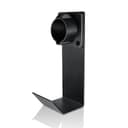
Lectron J1772 holster dock and J-hook
Lectron · J1772
A steel dock that latches a J1772 connector and a hook for the cable, rated by Lectron for indoor and outdoor use. Fits all J1772 connectors.
What is good
- Anti-corrosive steel rather than plastic
- Latches the connector so it stays put
- Hook keeps the cable off the ground
What is not
- J1772 only
- No holder for a portable's control box -- see the holder set
- Check your charger does not already have a holster
| Fits | All J1772 connectors |
|---|---|
| Material | Anti-corrosive steel |
| Use | Indoor or outdoor |
| In the box | Dock and J-hook, with mounting hardware |
Skip this if: Skip it if your connector is a Tesla (NACS) -- this dock is shaped for J1772.
Specifications above are the manufacturer’s published figures. Source: Lectron. We have not tested this unit — see how we pick.
2. Portable chargers
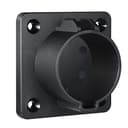
Lectron J1772 charger holder set
Lectron · J1772
A connector dock plus an adjustable holder that clamps a portable charger's control box to the wall -- most of what a wall unit gives you, for a portable that lives on a 14-50.
What is good
- Holds the portable's control box as well as the connector
- Adjustable arms fit different box widths
- Keeps a portable off the floor between trips
What is not
- J1772 only
- Plastic rather than steel
- Only useful if the portable stays mounted at home
| Fits | J1772 portable chargers, Level 1 or 2 |
|---|---|
| Box holder | Adjustable side arms to fit the control box |
| Material | ABS plastic |
| In the box | Box holder, connector holder, 7 mounting screws |
Skip this if: Skip it if you have a wall-mounted charger with its own holster; this set is built around a portable's control box.
Specifications above are the manufacturer’s published figures. Source: Lectron. We have not tested this unit — see how we pick.
FAQ
Questions people actually ask
How high should an EV charger be mounted?
Can I mount an EV charger outside?
Should the charger go near the panel or near the car?
Can one charger serve two parking spaces?
Sources
Where these numbers come from
- Charging Electric Vehicles at Home — U.S. Department of Energy, Alternative Fuels Data CenterOutdoor installation and use are safe with outdoor-rated equipment; EV charging is a continuous load under the NEC; permits may be required; an electrician can say whether a home has the capacity. Read 2026-09-23.
- Lectron J1772 EV charger J-hook nozzle holster dock — LectronHolster and J-hook dimensions, fitment and mounting.
- Lectron NEXUS Level 2 J1772 EV Charging Station, 240 V, 48 A, hardwired, 23 ft cable — Lectron48 A hardwired output, 23 ft cable, IP66 housing and listed standards.
Read next
Related reading
- How long should your EV charger cable be?How to measure your run properly, and which chargers have the longest cables.
- The best EV charger holsters and cable organizersHolsters and hooks that keep the connector off the floor and the cable out from under the wheels.
- Installing an EV charger outdoorsEnclosure ratings, weatherproof receptacles, mounting and the extra cost of an outdoor install.
- The best long-cable EV chargersThe 25 ft, 24 ft and 23 ft chargers ranked, plus the measurement to take before you buy.