Buying used
Refurbished and used EV chargers
People search for this constantly, so we went looking. The honest finding: refurbished home EV chargers are barely a market at all, and the reason that matters is the warranty.
By Sawyer V. · Published October 15, 2026
How this page is funded: we earn a commission if you buy through our Amazon links, at no extra cost to you. It does not change what we recommend, and we say plainly when the honest answer is to buy nothing. Full disclosure.
The verdict, and then the evidence. Buy a new charger. We went into this page expecting to compare refurbished options and instead found that they mostly do not exist: the large retail channel lists none, the two brands people search for by name do not run programs, and the one legitimate maker-direct refurb we found is for a dryer-outlet splitter rather than a charger. Where a genuine maker-backed refurbished unit with a real warranty and return window does exist, it is a reasonable buy. Everything else being sold as a cheap second-hand charger is resale with the warranty stripped out, on a device that lives on a continuous high-current circuit, and the discount is not worth it.
What we actually found when we looked
This is the part worth having in writing, because the search results for these terms are full of pages that imply a thriving refurbished market. Checked on 2026-10-15:
| Where we looked | What we found |
|---|---|
| Amazon's catalog, searched for renewed and refurbished chargers | No renewed or refurbished EV charger listings. Two searches, new units only. |
| Emporia (named in autocomplete as "refurbished emporia ev charger") | No program. The refurbished collection and product URLs return 404, on both their main and shop domains. |
| Grizzl-E / United Chargers | No verifiable program. The refurbished URL loads but serves the full new catalog at list price, with no refurbished SKU on it. |
| Splitvolt | A real program: a distinct refurbished SKU for the splitter switch, with a published return window and an optional extended warranty. |
| Marketplace and classified listings generally | Resale of used units. No maker testing, no warranty transfer, no returns. |
Why the warranty matters more on this product
Three reasons, and together they are why we land on "buy new" rather than "it depends".
- It is a continuous load on a big circuit. A charger draws its rated current for hours, which is why the branch circuit is sized at 125% of it under NEC Article 625 -- 40 amps needs a 50 amp circuit, 48 needs 60. A fault in a device doing that is not like a fault in a toaster.
- The certification belongs to the product, not the seller. UL or ETL listing is what tells you the unit was tested to a standard. A used unit's listing is intact in principle, but you have no record of what happened to it in between -- water, impact, a bad install, a previous fault. How to check certification covers the wording that counts.
- The warranty is the only enforceable part. Nobody, us included, has run these units for ten years. EV charger warranties compared makes that argument in full: the warranty is the part of the claim you can actually hold someone to, and a used unit has none.
There is a fourth, quieter reason. Chargers last a long time, which cuts against the used market rather than for it. How long does an EV charger last goes through it: the things that kill them are water ingress, connector wear and cable damage -- all of which are exactly the invisible history you inherit with a second-hand unit.
The arithmetic that kills most used deals
Work it as a total cost rather than a sticker. A used 40-amp charger at a meaningful discount still means: no warranty, no return window, no firmware support if it is a connected unit, and an unknown history. Against that, the entry price of a new, certified, warranted 40-amp charger from a brand with a service operation is lower than most people assume -- the budget tier on this site starts well below the mid-range, and best budget EV charger covers the cheapest options that are still properly certified.
The honest framing: on a laptop or a phone, refurbished is a good trade because the downside of a failure is inconvenience. On a device hardwired to a 60-amp circuit in your garage, the downside is different, and the saving is proportionally smaller. That is the whole argument.
One more cost people forget. If the used unit is a connected charger whose maker has stopped supporting it, you are buying the hardware and none of the software. That is not hypothetical -- what happened to JuiceBox owners is the case study, and a second-hand connected charger is exactly where that risk concentrates.
When refurbished IS a reasonable buy
We are not going to pretend the answer is never. A maker-direct refurbished unit is a genuinely different proposition from a marketplace resale, and the Splitvolt case is the useful example because the maker publishes the terms: a separate refurbished SKU rather than a quietly-relabeled return, a 30-day money-back guarantee, free shipping in the continental US, and an extended warranty available as a paid add-on. That is a transaction you can evaluate.
| Check | Why it matters | Walk away if |
|---|---|---|
| Maker-direct or authorized | Only the maker can test and re-warrant its own hardware | The seller is an individual or an unnamed reseller |
| A written warranty, with a term | It is the only enforceable part of the purchase | "Tested and working" is the whole guarantee |
| A return window | A charger's faults show up in the first weeks of real use | Sold as-is, no returns |
| Certification intact and legible | UL or ETL listing is what says it was tested to a standard | The label is missing, painted over or unreadable |
| The cable and connector, closely | These are the wear items and the expensive part to replace | Cuts in the jacket, melted pins, a loose latch |
| Enclosure integrity | Water ingress is a leading cause of failure outdoors | Cracks, missing gaskets, rust around the gland |
| Firmware and account status, on connected units | A charger locked to someone else's account is a brick | The seller cannot deregister it |
And one specific trap: do not buy a used charger whose amperage is wrong for your circuit on the theory that you will dial it down. Some chargers publish an adjustable range and some do not, and the setting is not always user-accessible. How many amps do you need is the sizing page, and buying the right rating new is cheaper than discovering the used one cannot be set.
What to buy new instead
Four units, all verified in stock on the date above, spanning the range most people shopping a used charger were trying to save money against. Honest cons on each -- none of these is the right answer for everyone.
The cheapest sensible new charger: Autel MaxiCharger 40 A
A 40-amp plug-in unit with a 25-foot cable, rated for indoor or outdoor use, on a NEMA 14-50 plug so it needs no hardwiring. This is the one that answers the used-charger question directly: it is the bottom of the sensible new market and it comes with a warranty and a company behind it.
Who it is for: anyone who was shopping used to save money. Who should skip it: anyone whose car accepts more than 9.6 kW and who has a 60-amp circuit -- step up a tier. Honest cons: 40 amps is not the fastest tier, it is plug-in rather than hardwired so it depends on the quality of your receptacle, and the full review covers what Autel does and does not publish.
The metal-case pick: Grizzl-E Ultimate 48 A
A cast-aluminum, UL Type 4 rated 48-amp unit with a 25-foot cable, Wi-Fi, OCPP and a published cold rating down to -22 F. The build-quality answer, and the one to look at if what attracted you to a used unit was getting a premium charger cheaply.
Who it is for: a 60-amp circuit and a cold or exposed garage. Who should skip it: anyone who wants a plug-in charger, because the Ultimate is hardwire only. Honest cons: hardwire only; United Chargers publishes adjustable steps that top out at 40 A on a 48 A unit, which is odd and we flag it in the review; and no ENERGY STAR listing on this model.
The warranty-and-support pick: DEWALT 48 A
A 48-amp hardwired charger with an LCD screen, an app, a three-year warranty and 24/7 technical support. If the reason you were considering refurbished was budget, this is the argument for spending slightly more: you are buying a support phone number as much as a charger.
Who it is for: anyone who wants a person to call. Who should skip it: anyone in a very cold garage -- DEWALT publishes no operating temperature range at all, which the comparison against the Wallbox covers. Honest cons: hardwire only, no published temperature range, CSA certified without naming the standard or a file number, and no ENERGY STAR listing.
The one product here with a real refurbished option: Splitvolt splitter switch
Included deliberately. If your reason for shopping used was that a new circuit is the expensive part rather than the charger, a splitter switch shares an existing 240-volt dryer outlet instead -- and it is the one product in this niche where a maker-direct refurbished version genuinely exists, with a published return window. Buy the new one if the gap is small; the refurbished SKU is a legitimate alternative if it is not.
Who it is for: a full electrical panel and a four-prong 14-30 dryer outlet. Who should skip it: anyone with panel space for a dedicated circuit, which charges at 40 amps instead of 24 and lets the dryer run at the same time. Honest cons: 24 amps is the ceiling on a 30-amp dryer circuit, the dryer and the car take turns, it is indoor use only, and the warranty is one year against the three a charger typically carries. Splitvolt vs NeoCharge is the head-to-head.
Who should buy what
| If this is you | Do this | Why |
|---|---|---|
| Shopping used purely on price | Buy a new 40 A charger | The entry price is lower than most expect, and it carries a warranty |
| Offered a maker-direct refurb with a written warranty and returns | Reasonable buy -- run the seven checks | This is the one version of refurbished that works |
| Offered a used unit by an individual | Walk away | No warranty, no returns, no history on a continuous-load device |
| Offered a used CONNECTED charger | Walk away unless it is deregistered | An account-locked charger is a brick; software support may be gone |
| The new CIRCUIT is the expensive part, not the charger | Consider a splitter switch | Shares an existing dryer outlet, no new circuit |
| You want premium build without premium price | Buy the metal-case 48 A new | Cheaper than the 80 A tier and the same enclosure |
| You want someone to call when it misbehaves | Buy the unit with 24/7 support | Support is the thing a used unit cannot give you |
If you landed here still deciding what rating to buy rather than whether to buy used, how to choose an EV charger is the page to read next, and best budget EV charger covers the cheapest new units that are still properly certified. If the thing you are really trying to avoid is the installation bill, EV charger installation cost has the published ranges.
New, certified, warranted
The cheapest sensible new charger, the metal-case option, the one with 24/7 support, and the splitter for when the circuit is the real cost. Live Amazon prices with the date they were read.
1. Long reach outdoors
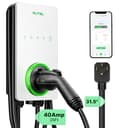
Autel MaxiCharger AC Home
Autel Energy · J1772 · 50 A / 12 kW · 25 ft cable
The 25 ft cable is the longest in this group, and the NEMA 4 case plus a cold-flexible cord make it the easiest unit to live with on an exposed outside wall.
What is good
- 25 ft cable, the longest of the wall units here
- Sold in NEMA 14-50, NEMA 6-50 and hardwired versions
- NEMA Type 4 enclosure rated for rain, snow, hail and sleet
- Wi-Fi and Bluetooth, so it still works if the Wi-Fi drops
What is not
- The 50 A version is hardwired only
- The app has more features than a first-time owner needs
| Maximum output | 50 A / 12 kW hardwired; 40 A / 9.6 kW plug-in |
|---|---|
| Connector | SAE J1772 |
| Cable | 25 ft |
| Enclosure | NEMA Type 4 |
| Certification | Tested to UL standards by CSA |
| Warranty | 3 years |
Skip this if: Skip it if your parking spot is right next to the panel. You are paying for cable you will coil up and never use.
Specifications above are the manufacturer’s published figures. Source: Autel Energy. We have not tested this unit — see how we pick.
2. Ultimate build quality on a 60 A circuit
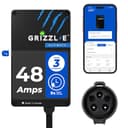
Grizzl-E Ultimate 48A
United Chargers · J1772 + NACS · 48 A / 11.5 kW · 25 ft cable
The Ultimate's hardware at the amperage most houses can feed: 48 A and 11.5 kW, hardwired, Wi-Fi and OCPP, in the same cast-aluminum Type 4 case. The catch is what United Chargers publishes about dialing it down -- the adjustable steps stop at 40 A.
What is good
- 48 A on a 60 A circuit, which a normal 200 A panel can usually spare
- Same cast-aluminum UL Type 4 case and -22 F rating as the 80 A Ultimate
- 25 ft cable, the long end of the range
- Wi-Fi, a mobile app and OCPP, so it is not locked to one vendor's cloud
- Offered with either a J1772 or a NACS connector
What is not
- Hardwire only -- there is no plug-in version of the Ultimate
- United Chargers publishes adjustable steps of 40/32/24/16 A, so the published step list does not include 48 A itself
- No ENERGY STAR certification listed, unlike the 80 A Ultimate
- A J1772 unit needs an adapter on every charge if you drive a NACS car
- Costs more than the 40 A Grizzl-E Classic for speed many owners will not use
| Maximum output | 48 A / 11.5 kW |
|---|---|
| Adjustable current | 40 A, 32 A, 24 A, 16 A (as published) |
| Connector | J1772 or NACS, chosen at purchase |
| Cable | 25 ft (7.6 m) |
| Installation | Hardwire only |
| Enclosure | Aluminum, UL Type 4 indoor/outdoor rating |
| Operating temperature | -30 C to +50 C (-22 F to 122 F) |
| Connectivity | Wi-Fi (2.4 GHz), mobile app, OCPP |
| Certification | UL, file E510712 |
| Weight | 11.00 kg / 24.25 lb, shipped |
| Enclosure size | 10.25 x 6.25 x 3.75 in |
| Country of origin | Canada, per United Chargers |
| Model number | GRS-077-W-HW-25N48-A-GB |
| Warranty | 3 years, or 5 years |
Skip this if: Skip it if your car accepts more than 11.5 kW and your panel can carry a 100 A circuit -- that is what the 80 A model is for. Skip it too if you want a plug-in unit; this is hardwire only.
Specifications above are the manufacturer’s published figures. Source: United Chargers. We have not tested this unit — see how we pick.
3. A familiar brand, hardwired
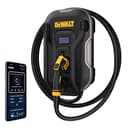
DEWALT 48 A EV Charger (DXPAEV048)
DEWALT · J1772 · 48 A / 11.5 kW · 25 ft cable
A 48 A hardwired charger with a 25 ft cable, an LCD screen and an app, from a brand most garages already trust. Adjustable from 12 A, IP66, CSA certified, three-year warranty.
What is good
- 48 A / 11.5 kW, the top tier a normal 60 A home circuit supports
- Adjustable from 12 A, a wider floor than most chargers offer
- 25 ft cable with a protective cage and an anti-slip handle
- An LCD screen on the unit, so basic status does not depend on a phone
- Scheduling and energy monitoring in a free app, with no subscription
- A three-year warranty backed by 24/7 technical support, and a national install partner
What is not
- Hardwired only -- DEWALT's plug-in version is the separate 40 A model
- DEWALT publishes no operating temperature range for it
- CSA certified, but DEWALT does not name the standard or publish a file number the way Grizzl-E and Lectron do
- No ENERGY STAR certification listed, unlike several rivals at this price
- J1772 only, so a NACS car needs an adapter on every charge
- Costs more than the 48 A chargers most first-time buyers end up with
| Maximum output | 48 A / 11.5 kW |
|---|---|
| Adjustable | 12 A to 48 A |
| Connector | SAE J1772 (DEWALT notes a Tesla adapter is sold separately) |
| Cable | 25 ft, UL certified, with a protective cage and anti-slip handle |
| Installation | Hardwired; mounting bracket and hardware included |
| Enclosure | IP66, described as a NEMA 4X type enclosure |
| Display | LCD screen on the unit |
| Connectivity | Bluetooth and Wi-Fi, through the free DEWALT EV Charger app |
| App features | Start and stop charging, energy monitoring, off-peak scheduling |
| Certification | CSA certified for indoor and outdoor use |
| Maker's range claim | Up to 46 miles of range per hour |
| Warranty | 3-year limited, with 24/7 technical support |
Skip this if: Skip it if you want a plug-in unit -- this one is hardwired, and DEWALT's plug-in version is the 40 A model. Skip it too if a published temperature range matters to you; DEWALT does not list one.
Specifications above are the manufacturer’s published figures. Source: DEWALT. We have not tested this unit — see how we pick.
4. A 14-30 dryer outlet and a charger with a 14-50 plug
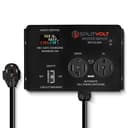
Splitvolt Splitter Switch (NEMA 14-30 to 14-50)
Splitvolt · NEMA 14-50 · 24 A / 5.8 kW
The one most people need: it plugs into a four-prong 14-30 dryer outlet and gives the charger a NEMA 14-50 socket, which is the plug nearly every plug-in EV charger ships with. Still 24 A, because the dryer circuit is still 30 A.
What is good
- A 14-50 EV socket, which is the plug most plug-in chargers already have
- Fits the four-prong 14-30 dryer outlet modern circuits use
- Automated switching, full-color metering display and an easy-reset 24 A breaker
- cETLus listed with the Intertek file number published
- No new circuit, so no panel upgrade
What is not
- A 14-50 socket that still only delivers 24 A -- the outlet looks faster than it is
- The dryer and the charger take turns; they cannot run together
- Indoor use only
- 1-year warranty
| Rating | 240 V ~ 60 Hz, 24 A AC maximum load |
|---|---|
| Wall plug | NEMA 14-30 male, on a 4 ft pigtail |
| Dryer socket | NEMA 14-30 female |
| EV socket | NEMA 14-50 female |
| Switching | Automated between the dryer and EV sockets |
| Display | Full-color screen: real-time kWh, amps, volts and status |
| Protection | Integrated 24 A circuit breaker with easy reset |
| Manual override | Optional manual power-off switch |
| Circuit | Standard 30 A dryer circuits; 24 A max for the NEC safe charging rate |
| Mounting | Integrated wall-mount screw holes |
| Use | Indoor use only |
| Size and weight | 12 x 8.5 x 4 in, 6.7 lb |
| Certification | cETLus, Intertek 5021938, UL 60730-1 / CSA E60730-1 |
| Warranty | 1 year limited |
| SKU | SPS-C2-032-30A |
Skip this if: Skip it if your dryer outlet is the older three-prong 10-30, or if your panel has room for a dedicated circuit -- a real 14-50 circuit charges at 40 A instead of 24 A.
Specifications above are the manufacturer’s published figures. Source: Splitvolt. We have not tested this unit — see how we pick.
FAQ
Questions people actually ask
Can you buy a refurbished EV charger?
Is it safe to buy a used EV charger?
Is a refurbished EV charger worth the savings?
What is the difference between refurbished and used?
What should I check before buying a used EV charger?
Does a used connected charger still work?
Sources
Where these numbers come from
- Splitvolt Safety Certified Splitter Switch NEMA 14-30 / 14-50 (Refurbished) — SplitvoltA distinct refurbished SKU, RFB-SPS-C2-032-30A-R, listed below the price of the new unit. Dryer outlet NEMA 14-30, EV charger outlet NEMA 14-50. Splitvolt offers a 30-day money back guarantee and free shipping in the continental US, and sells a 4-year extended warranty for the splitter switch as a separate add-on. Read 2026-10-15.
- Splitvolt Splitter Switch (NEMA 14-30/14-50, 240 V, 24 A), cETLus certified — SplitvoltThe new equivalent of the refurbished SKU above: SKU SPS-C2-032-30A, 240 V ~ 60 Hz 24 A maximum load, automated switching, full-color display, integrated 24 A breaker with easy reset, Intertek cETLus listed 5021938, indoor use only, 1-year limited warranty. Read 2026-10-12.
- Grizzl-E product catalog — United ChargersChecked 2026-10-15 for a refurbished program. The URL resolves (HTTP 200) but serves the full new catalog at list price -- Classic Connect 40A, Classic 40A, Duo Connect 40A, Mini Connect 40A, Ultimate 48A and Ultimate 80A, plus accessories -- with no refurbished SKU listed. No refurbished program could be verified for this brand.
- WireRef NEC Article 625: EV charging equipment — WireRefEV charging equipment is treated as a continuous load, so the branch circuit is sized at 125% of the charger's rated current; NEC Article 625 governs EV supply equipment. Read 2026-10-15.
- ENERGY STAR certified electric vehicle chargers — U.S. EPA, ENERGY STARCertified chargers are tested by a nationally recognized testing laboratory and use less energy when idle. Read 2026-10-15.
- Charging Electric Vehicles at Home — U.S. Department of Energy, Alternative Fuels Data CenterMost drivers charge overnight at home; outdoor charging is safe with equipment rated for outdoor use; smarter Level 2 units add timers and monitoring. Read 2026-10-15.
Read next
Related reading
- EV charger warranties, comparedPublished warranty terms side by side, what they typically exclude, and why it matters here.
- How long does an EV charger last?What wears out on a home charger, what the three-year warranties cover, and the checks to run.
- The cheapest home EV charger that is still a good ideaThe cheapest Level 2 chargers that are still properly certified, and the corners not to cut.
- How to check an EV charger's safety certificationWhat UL, ETL and CSA marks mean, and the wording designed to look like certification.
- Your JuiceBox still charges. The app is gone.What the Enel X Way shutdown did and did not break, and the replacements worth buying if scheduling matters to you.