Dryer-outlet charging
Splitvolt vs NeoCharge
Both share a 240-volt outlet you already own, and both are safety-listed. The decision is not really brand against brand -- it is which socket is on your laundry-room wall, and whether your circuit is 30 amps or 50.
By Sawyer V. · Published October 8, 2026
How this page is funded: we earn a commission if you buy through our Amazon links, at no extra cost to you. It does not change what we recommend, and we say plainly when the honest answer is to buy nothing. Full disclosure.
The verdict, up front. If you have a 30-amp dryer outlet -- which is almost everyone asking this question -- the two brands charge at the same 24 amps and the choice comes down to availability and the socket you need: Splitvolt, in the 14-30 to 14-50 version, is the one we would buy, because it is on Amazon and its EV socket matches the NEMA 14-50 plug most portable chargers ship with. If your laundry or garage outlet is a 14-50, 10-50 or 6-50 on a 50-amp circuit, buy NeoCharge instead: its versions for those outlets are rated 40 amps, and that is a real difference you will feel every night. Either way, a dedicated circuit beats both if your panel can take one.
Side by side
| Splitvolt Splitter Switch | NeoCharge Smart Splitter | |
|---|---|---|
| Maximum output | 24 A, 240 V, on every model | 24 A on 10-30 and 14-30; 40 A / 9.6 kW on 14-50, 10-50 and 6-50 |
| Switching | Automated between dryer and EV sockets | Automated between the two loads |
| Safety listing | cETLus, Intertek file 5021938, to UL 60730-1 / CSA E60730-1 | UL listed |
| Overcurrent protection | Integrated 24 A breaker with easy reset | Internal software breaker |
| Display | Full-color screen: real-time kWh, amps, volts, status | Not published; the review notes app scheduling |
| Manual override | Optional manual power-off switch | Not published |
| Outlet versions | 10-30, 14-30, and 14-30 in with a 14-50 EV socket | 10-30, 14-30, 14-50, 10-50, 6-50 |
| Mounting | Wall-mount screw holes and a 4 ft pigtail plug | Plug-in |
| Weight | 6.7 to 7 lb | 2.5 lb |
| Size | 12 x 8.5 x 4 in | Not published |
| Environment | Indoor use only | Indoor plug-in device |
| Warranty | 1 year limited | Manufacturer limited warranty; no term published |
| Sold on Amazon | Yes -- three models, all verified in stock | No NeoCharge-branded listing found |
Speed: the circuit decides, not the brand
This is the part most comparisons get wrong by implying one splitter is faster. A splitter cannot create capacity. A dryer circuit is 30 amps, a continuous load may use 80% of its circuit, and 80% of 30 is 24. Both brands land on 24 amps for the same reason, and both enforce it with an internal breaker rather than trusting you to.
What 24 amps actually delivers
24 A x 240 V = 5,760 W, which is 5.76 kW.
Miles per hour = charger kW / (your car's kWh per 100 miles) x 100.
An efficient sedan at 25 kWh/100 mi: 5.76 / 25 x 100 = about 23 miles per hour.
A mid-size SUV at 37 kWh/100 mi: 5.76 / 37 x 100 = about 16 miles per hour.
An electric truck at 50 kWh/100 mi: 5.76 / 50 x 100 = about 12 miles per hour.
| Your car | 24 A (either brand, 30 A circuit) | 40 A (NeoCharge on a 50 A circuit) |
|---|---|---|
| Efficient sedan, 25 kWh/100 mi | about 23 mi/h, 230 mi overnight | about 38 mi/h, 380 mi overnight |
| Compact SUV, 32 kWh/100 mi | about 18 mi/h, 180 mi overnight | about 30 mi/h, 300 mi overnight |
| Mid-size SUV, 37 kWh/100 mi | about 16 mi/h, 160 mi overnight | about 26 mi/h, 260 mi overnight |
| Electric truck, 50 kWh/100 mi | about 12 mi/h, 120 mi overnight | about 19 mi/h, 190 mi overnight |
Read the left column against your own driving before you worry about the right one. The average US driver covers well under 40 miles a day, and 160 miles overnight covers that several times over. The 40-amp column matters for a truck, a long commute, or a two-EV household -- and in those cases a dedicated circuit is usually the better answer than a bigger splitter.
The outlet-matching trap, which is the real decision
Three plugs have to agree: the one on your wall, the socket the splitter hands you, and the one on your charger. Get any pair wrong and the box goes back. Splitvolt publishes all three for each model, so this is checkable before you buy:
| Outlet on your wall | Model | Socket you get for the charger | SKU |
|---|---|---|---|
| NEMA 10-30 (three prongs, older dryer) | Splitvolt NEMA 10-30 | NEMA 10-30 | SPS-C1-011-30A |
| NEMA 14-30 (four prongs, modern dryer) | Splitvolt NEMA 14-30 | NEMA 14-30 | SPS-C2-022-30A |
| NEMA 14-30 (four prongs, modern dryer) | Splitvolt NEMA 14-30 to 14-50 | NEMA 14-50 | SPS-C2-032-30A |
Certification: different marks, same standing
NeoCharge says UL listed. Splitvolt says cETLus listed by Intertek, file 5021938, conforming to UL 60730-1 and certified to CSA E60730-1. Those are different testing laboratories, not different levels of safety: both UL and Intertek are nationally recognized testing laboratories, and a cETLus mark to a UL standard means the product was tested against that same standard. Splitvolt publishing the file number is a point in its favor, because a file number is checkable and a logo is not. How to check a certification covers doing that.
What matters far more than which mark: it must have one. Unlisted Y-splitters and dual-socket adapter cords for 240-volt circuits are sold everywhere and are a genuinely bad idea -- they let both loads draw at once with nothing to stop them. Never a plain splitter explains why the switching is the whole product.
Where you can actually buy each
This is a practical difference worth stating plainly. All three Splitvolt models are listed on Amazon and were verified in stock on the day this page was written. NeoCharge is not: a search of Amazon's catalog for the brand and model returns no NeoCharge-branded listing at all -- what comes back is Splitvolt, VEVOR, and a row of unbranded automatic switches. NeoCharge is sold direct by the maker, which is fine, but it means the two are not equally easy to buy and we earn nothing if you choose it. We would still tell you to choose it on a 50-amp outlet.
Who should buy which
| If this is you | Buy | Why |
|---|---|---|
| Four-prong 14-30 dryer outlet, charger with a 14-50 plug | Splitvolt 14-30 to 14-50 | The only model here that hands you a 14-50 socket; no adapter in the chain |
| Four-prong 14-30 outlet, charger with a 14-30 plug | Splitvolt 14-30 | Matching sockets both sides |
| Older three-prong 10-30 dryer outlet | Splitvolt 10-30, or NeoCharge's 10-30 version | Both are made for it, both cap at 24 A |
| A 14-50, 10-50 or 6-50 outlet on a 50 A circuit | NeoCharge | Those versions are rated 40 A / 9.6 kW -- Splitvolt has no 40 A model |
| You want real-time energy and amperage on the device | Splitvolt | Publishes a full-color screen with live kWh, amps and volts |
| You want the lightest unit hanging off the wall | NeoCharge | 2.5 lb against 6.7 to 7 lb |
| Your panel has two free breaker spaces | Neither -- fit a dedicated circuit | 40 A charging, and the dryer runs at the same time |
| You were about to buy an unlisted Y-splitter cord | Neither. Stop. | Nothing limits the combined draw; this is how circuits are overloaded |
What neither of them fixes
- They take turns. The dryer and the car cannot draw at once -- that is the point of the switching. If someone does laundry at 11 pm, charging pauses.
- Your charger must cooperate. It has to be settable to 24 A or less. Many are; some cheap ones are not. How many amps do you need covers reading your charger's adjustable range.
- Indoor only. Splitvolt publishes indoor use only, and NeoCharge is an indoor plug-in device. A laundry room is fine; an exterior wall is not.
- They do not add capacity to a tired panel. If your service is already near its limit, a splitter avoids a new circuit but does not change the load calculation. Panel load calculation.
- The warranty is short. Splitvolt publishes one year. A charger usually carries three. Factor that in, because this device sits between your dryer circuit and a car.
And the honest alternative we keep coming back to: if your panel has room, a dedicated 14-50 circuit costs money once and then charges at 40 amps forever with no device in the middle and no laundry conflicts. What a NEMA 14-50 install costs has the published numbers. A splitter is the right answer when that circuit is genuinely not available -- a full panel, a rental, or a quote that came back at four figures.
Both brands, and the model that fits your wall
The three Splitvolt models in the order most readers need them, and NeoCharge for a 50-amp outlet. Prices are live from Amazon and carry the date they were read; NeoCharge has no Amazon listing, so its row links to a model search.
1. A 14-30 dryer outlet and a charger with a 14-50 plug
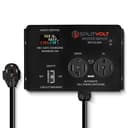
Splitvolt Splitter Switch (NEMA 14-30 to 14-50)
Splitvolt · NEMA 14-50 · 24 A / 5.8 kW
The one most people need: it plugs into a four-prong 14-30 dryer outlet and gives the charger a NEMA 14-50 socket, which is the plug nearly every plug-in EV charger ships with. Still 24 A, because the dryer circuit is still 30 A.
What is good
- A 14-50 EV socket, which is the plug most plug-in chargers already have
- Fits the four-prong 14-30 dryer outlet modern circuits use
- Automated switching, full-color metering display and an easy-reset 24 A breaker
- cETLus listed with the Intertek file number published
- No new circuit, so no panel upgrade
What is not
- A 14-50 socket that still only delivers 24 A -- the outlet looks faster than it is
- The dryer and the charger take turns; they cannot run together
- Indoor use only
- 1-year warranty
| Rating | 240 V ~ 60 Hz, 24 A AC maximum load |
|---|---|
| Wall plug | NEMA 14-30 male, on a 4 ft pigtail |
| Dryer socket | NEMA 14-30 female |
| EV socket | NEMA 14-50 female |
| Switching | Automated between the dryer and EV sockets |
| Display | Full-color screen: real-time kWh, amps, volts and status |
| Protection | Integrated 24 A circuit breaker with easy reset |
| Manual override | Optional manual power-off switch |
| Circuit | Standard 30 A dryer circuits; 24 A max for the NEC safe charging rate |
| Mounting | Integrated wall-mount screw holes |
| Use | Indoor use only |
| Size and weight | 12 x 8.5 x 4 in, 6.7 lb |
| Certification | cETLus, Intertek 5021938, UL 60730-1 / CSA E60730-1 |
| Warranty | 1 year limited |
| SKU | SPS-C2-032-30A |
Skip this if: Skip it if your dryer outlet is the older three-prong 10-30, or if your panel has room for a dedicated circuit -- a real 14-50 circuit charges at 40 A instead of 24 A.
Specifications above are the manufacturer’s published figures. Source: Splitvolt. We have not tested this unit — see how we pick.
2. A modern four-prong 14-30 dryer outlet
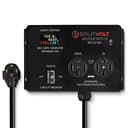
Splitvolt Splitter Switch (NEMA 14-30)
Splitvolt · NEMA 14-30 · 24 A / 5.8 kW
The four-prong version: it plugs into a modern NEMA 14-30 dryer outlet and gives you a 14-30 socket for the charger. Same 24 A ceiling, same automated switching and color display as the rest of the range.
What is good
- Matches the four-prong 14-30 outlet modern dryer circuits actually use
- Automated switching between dryer and EV, with a full-color status display
- Integrated 24 A breaker with an easy reset, enforcing the circuit limit
- cETLus listed with the Intertek file number published
- Plugs in; no electrician needed for the splitter itself
What is not
- The EV socket is a 14-30, so a 14-50 charger plug needs the other model
- 24 A ceiling -- roughly 20 miles of range per hour
- Indoor use only
- 1-year warranty, shorter than the 3 years a charger typically carries
| Rating | 240 V ~ 60 Hz, 24 A AC maximum load |
|---|---|
| Wall plug | NEMA 14-30 male, on a 4 ft pigtail |
| Dryer socket | NEMA 14-30 female |
| EV socket | NEMA 14-30 female |
| Switching | Automated between the dryer and EV sockets |
| Display | Full-color screen: real-time kWh, amps, volts and status |
| Protection | Integrated 24 A circuit breaker with easy reset |
| Manual override | Optional manual power-off switch |
| Circuit | Standard 30 A dryer circuits; 24 A max for the NEC safe charging rate |
| Mounting | Integrated wall-mount screw holes |
| Use | Indoor use only |
| Size and weight | 12 x 8.5 x 4 in, 7 lb |
| Certification | cETLus, Intertek 5021938, UL 60730-1 / CSA E60730-1 |
| Warranty | 1 year limited |
| SKU | SPS-C2-022-30A |
Skip this if: Skip it if your charger has a NEMA 14-50 plug -- the EV socket here is a 14-30, so buy the 14-30/14-50 model instead.
Specifications above are the manufacturer’s published figures. Source: Splitvolt. We have not tested this unit — see how we pick.
3. Older 10-30 dryer outlets
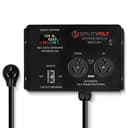
Splitvolt Splitter Switch (NEMA 10-30)
Splitvolt · NEMA 10-30 · 24 A / 5.8 kW
Shares an older three-prong 30-amp dryer outlet between the dryer and the charger, with an internal breaker holding charging to 24 A. This model's EV socket is also a NEMA 10-30; Splitvolt sells a separate version with a 14-50 EV outlet. cETLus listed with a published file number.
What is good
- cETLus listed, with the Intertek file number published
- Integrated 24 A breaker keeps charging inside the limit of a 30 A circuit
- Switches between dryer and EV automatically -- no plug swapping
- Full-color display reports real-time kWh, amps and volts
- Plugs in -- the splitter itself needs no electrician installation
What is not
- Your charger must be able to limit itself to 24 A
- The EV socket is a NEMA 10-30, so a charger with a 14-50 plug needs a different model
- 24 A is about 20 miles of range per hour -- slow for a big battery
- Indoor use only, and a 1-year warranty against the 3 years most chargers carry
| Rating | 240 V ~ 60 Hz, 24 A AC maximum load |
|---|---|
| Wall plug | NEMA 10-30 male, on a 4 ft pigtail |
| Dryer socket | NEMA 10-30 female |
| EV socket | NEMA 10-30 female |
| Switching | Automated between the dryer and EV sockets |
| Display | Full-color screen: real-time kWh, amps, volts and status |
| Protection | Integrated 24 A circuit breaker with easy reset |
| Manual override | Optional manual power-off switch |
| Circuit | Standard 30 A dryer circuits; 24 A max for the NEC safe charging rate |
| Mounting | Integrated wall-mount screw holes |
| Use | Indoor use only |
| Size and weight | 12 x 8.5 x 4 in, 6.7 lb |
| Certification | cETLus, Intertek 5021938, UL 60730-1 / CSA E60730-1 |
| Warranty | 1 year limited |
| SKU | SPS-C1-011-30A |
Skip this if: Skip it if your dryer outlet is a four-prong 14-30 or a 14-50 -- buy the splitter version made for that outlet instead.
Specifications above are the manufacturer’s published figures. Source: Splitvolt. We have not tested this unit — see how we pick.
4. The broadest outlet range
NeoCharge Smart Splitter
NeoCharge · NEMA 14-50 · 40 A / 9.6 kW
Plugs into an existing 240-volt outlet and switches power between your dryer and your EV automatically, so you get Level 2 charging without a new circuit. UL listed, and sold in a version for each common dryer and range outlet.
What is good
- Avoids a new circuit, which can mean avoiding a panel upgrade
- Switches between the two loads automatically
- UL listed, with an internal breaker that enforces the circuit limit
- A version for every common dryer and range outlet type
What is not
- The dryer and the charger take turns on the circuit
- On a 30 A dryer circuit you are limited to 24 A of charging
- You must buy the version that matches your outlet exactly
| Output (14-50 version) | 40 A / 9.6 kW |
|---|---|
| Input (14-50 version) | NEMA 14-50P, 240 VAC single phase |
| Outputs (14-50 version) | 2 x NEMA 14-50R |
| Also sold for | NEMA 10-30 and 14-30 (24 A), NEMA 10-50 and 6-50 (40 A) |
| Protection | Internal software breaker |
| Weight | 2.5 lb |
| Certification | UL listed |
Skip this if: Skip it if your panel can take a new circuit. A dedicated EV circuit is simpler, charges while the dryer runs, and has one less device in the chain.
Specifications above are the manufacturer’s published figures. Source: NeoCharge. We have not tested this unit — see how we pick.
FAQ
Questions people actually ask
Is Splitvolt or NeoCharge better?
How fast does a dryer-outlet splitter charge?
Which Splitvolt model do I need?
Can you buy NeoCharge on Amazon?
Is a dryer outlet splitter safe?
Is a splitter better than a dedicated circuit?
Sources
Where these numbers come from
- Splitvolt Splitter Switch (NEMA 14-30/14-50, 240 V, 24 A), cETLus certified — SplitvoltWall socket NEMA 14-30 male, dryer outlet NEMA 14-30 female, EV outlet NEMA 14-50 female; maximum load 240 V ~ 60 Hz 24 A AC; automated power switching between dryer and EV sockets; full-color display screen and LED status lights with real-time voltage, current, kWh and status; integrated 24 A circuit breaker with easy reset; optional manual power-off switch; supports standard 30 A dryer circuits, max 24 A for the NEC safe charging rate; indoor use only; 1-year limited warranty; 6.7 lb; 12 x 8.5 x 4 in; SKU SPS-C2-032-30A. Read 2026-10-08.
- Splitvolt Splitter Switch (NEMA 14-30, 240 V, 24 A), cETLus certified — SplitvoltWall socket NEMA 14-30 male, dryer outlet NEMA 14-30 female, EV outlet NEMA 14-30 female; maximum load 240 V ~ 60 Hz 24 A AC; Intertek, conforms to UL STD 60730-1, certified to CSA STD E60730-1, cETLus listed Intertek 5021938; integrated wall-mount screw holes and 4 ft pigtail plug; indoor use only; 1-year limited warranty; 7 lb; 12 x 8.5 x 4 in; SKU SPS-C2-022-30A. Read 2026-10-08.
- Splitvolt Splitter Switch (NEMA 10-30, 240 V, 24 A), cETLus certified — SplitvoltWall socket NEMA 10-30 male, dryer socket NEMA 10-30 female, EV socket NEMA 10-30 female; maximum load 240 V ~ 60 Hz 24 A AC; automated power switching; full-color display with real-time voltage, current and kWh; integrated 24 A breaker with easy reset; indoor use only; 1-year limited warranty; 6.7 lb; SKU SPS-C1-011-30A. Read 2026-10-08.
- NeoCharge Smart Splitter — NeoChargeOutlet versions, output ratings, weight, protection and UL listing: 40 A / 9.6 kW on the 14-50 version with a NEMA 14-50P input and two NEMA 14-50R outputs; also sold for NEMA 10-30 and 14-30 at 24 A and for NEMA 10-50 and 6-50 at 40 A; internal software breaker; 2.5 lb; UL listed. Fetched 2026-09-10.
- Electric Vehicle Charging Infrastructure: AC Level 2 equipment — U.S. Department of Energy, Alternative Fuels Data CenterAC Level 2 runs at 240 V in homes, delivers 2.9 to 19.2 kW, and adds roughly 25 miles of range per hour of charging. AC Level 1 adds approximately 5 miles of range per hour. Read 2026-10-08.
Read next
Related reading
- NeoCharge Smart Splitter review24 A or 40 A versions, automatic switching and app scheduling: who a dryer-outlet splitter suits.
- The best dryer outlet splitters for EV chargingCharge from your dryer outlet instead of adding a circuit, and the 24-amp limit that comes with it.
- Charging an EV from a dryer outletWhat a 30 A dryer circuit allows, why 24 A is the ceiling, and which listed splitters do it safely.
- What it costs to install a NEMA 14-50 outletWhat drives the price of a 240 V outlet for charging, and the part not to cheap out on.
- Does an EV charger need its own circuit?The dedicated-circuit rule, the energy-management exception, and what it means for your panel.