Storm season
EV charging in a power outage
A home charger is a grid appliance: no grid, no charging. The useful question is not how to power the charger, but how to get miles into the car -- and the cheapest answer costs nothing and happens the night before.
By Sawyer V. · Published October 17, 2026

How this page is funded: we earn a commission if you buy through our Amazon links, at no extra cost to you. It does not change what we recommend, and we say plainly when the honest answer is to buy nothing. Full disclosure.
The verdict, stated plainly: there is no good way to charge an electric car during a power cut, and there is an excellent way to prepare for one. Plug in every night, especially when a storm is forecast, and the car is already carrying two or three hundred miles when the lights go out. That is enough for days of errands and one long evacuation drive. Everything below is for the case where the outage arrives with the car already low, or lasts long enough to matter.
Why the charger stops at all
A Level 2 charger is a switch and a safety device, not a power source. The Department of Energy describes Level 2 equipment as working from 240 V electrical service; the charger negotiates with the car, protects the circuit and passes the utility's electricity through. When the service goes, so does everything downstream of it. Nothing in the car can feed the charger either -- the car's charge port is an inlet, and its 12-volt accessory socket is nowhere near the power a charger needs.
The three options, honestly ranked
| Option | What you get | The catch |
|---|---|---|
| Charging before the outage | 200-300 miles, free | Requires having thought about it the night before |
| Home battery | About 12 miles per 5 kWh unit | 3.84 kW continuous means the charger must be set near 16 A |
| Portable charger, somewhere with power | Level 2 speed from any 240 V outlet that works | Someone else needs power, and you need to ask |
| Generator | Genuinely useful for a multi-day outage | Grounding, noise, fuel, and a poor cost per mile |
| Vehicle-to-home | The car powers the house, not the reverse | Specific maker hardware; not an ordinary Level 2 charger |
The home-battery arithmetic, in one line
One 5 kWh home battery, into a car
5.0 kWh stored x 90% AC round-trip efficiency = about 4.5 kWh delivered.
4.5 kWh / 0.37 kWh per mile (Cadillac Lyriq) = about 12 miles.
3.84 kW continuous / 240 V = about 16 A, so that is the charger setting it can feed.
Twelve miles is an errand. It is not nothing in an emergency, and it is not a charge. Charging an EV from a home battery works through the capacity and power limits properly, including what happens when you stack batteries. One detail worth knowing now: on the Enphase system, backup operation at all requires the maker's system controller, so a battery sold purely for self-consumption may do nothing for you in an outage. Ask whoever installed it which circuits it is wired to feed.
The portable charger is the underrated answer
Outages are local. If your street is dark and your sister's street is not, the fastest route to a charged car is to drive to a 240-volt outlet that works -- hers, a relative's, a workplace, an RV hookup -- with a portable Level 2 charger in the trunk. It plugs into a NEMA 14-50 and drops to a standard wall outlet with the supplied adapter. Outlet types for travel charging covers what you will meet, and charging at a hotel or Airbnb covers asking politely.
The same logic applies to public charging. The Department of Energy's own station locator exists for exactly this, and a working DC fast charger a few miles away beats any amount of hardware in your garage. Home vs public charging has the comparison.
Generators: read the grounding section first
A generator can charge a car and it is the right tool for a multi-day outage at a house that needs one anyway. It is not a plug-and-go answer: most portable generators present a grounding arrangement that an EV charger's ground-fault detection rejects, which is the thing that stops people rather than the fuel bill. That page exists in full: charging an EV with a generator, including the fix and the warning attached to it.
The thing to actually buy: surge protection
The electrical event that damages equipment is usually not the outage. It is the restoration -- and the switching, reclosing and lightning activity around it. A panel-mounted surge protective device sits ahead of every circuit in the house, the EV charger included. The two on the buy rows below are a Type 2 unit rated 140 kA per phase in a NEMA 4X enclosure with a 10-year warranty, and a Type 1 unit rated 80 kA per phase that can be installed on either side of the main disconnect, which gives your electrician more placement options.
When the power comes back
- Give it a minute. Chargers run a self-test and the car re-negotiates the session. A charger that looks dead for thirty seconds is often not.
- Check the breaker, including the GFCI. A restoration transient is a classic trip, and a GFCI breaker that has tripped looks exactly like a dead charger. GFCI nuisance tripping is the page for that, and it is one of the most-read pages on this site for a reason.
- Check the schedule. If the car or the charger holds a departure-time schedule, a clock that lost power may have moved it. Time-of-use charging covers where to set it, and the rule of setting it in one place only.
- Then start fault-finding. If it is still not charging, work through EV charger not working rather than buying anything.
What to own before the next one
Surge protection for the panel, and a portable charger so power that works somewhere else is power you can use. Live Amazon prices with the date they were read.
1. Highest surge rating
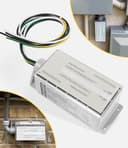
Siemens FS140 whole-home surge protector
Siemens · Panel-mounted
The highest surge-current rating of the three here at 140 kA per phase, in a NEMA 4X enclosure. Mounted at the panel, it protects every circuit in the house -- the EV charger included.
What is good
- 140 kA per phase, the highest rating here
- Three status indicators, including an audible alarm
- NEMA 4X enclosure, rated for outdoor mounting
- Protects every circuit, not just the charger
What is not
- Installation is licensed electrical work
- No surge protector is a guarantee against every event
- Overkill if a lower-rated unit covers your service
| Type | Type 2 surge protective device |
|---|---|
| Surge current | 140 kA per phase |
| Breaker | 30 A or smaller, 2-pole |
| System | 120/240 V, 60 Hz split-phase |
| Status indicators | Audible alarm, protection LED, service LED |
| Enclosure | NEMA 4X, outdoor-rated |
| Warranty | 10 years, as published |
Skip this if: Skip it if you already have a whole-home surge protector at your panel. One is enough; a second adds nothing.
Specifications above are the manufacturer’s published figures. Source: Crosswyre Electric. We have not tested this unit — see how we pick.
2. Type 1 placement
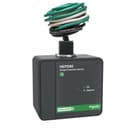
Square D HEPD80 whole-home surge protector
Square D (Schneider Electric) · Panel-mounted
The only Type 1 unit here, so it can be installed on either side of the main disconnect -- including ahead of the main breaker -- which gives your electrician more placement options. 80 kA per phase in a NEMA 4X enclosure.
What is good
- Type 1, so it can go ahead of the main breaker as well as after it
- NEMA 4X, resistant to corrosion and water
- A real step up from no whole-home protection
What is not
- Lowest surge rating of the three at 80 kA per phase
- Shortest published warranty of the three
- Installation is licensed electrical work
| Type | Type 1 surge protective device, UL 1449 3rd Edition |
|---|---|
| Surge current | 80 kA per phase |
| System | 120/240 V single-phase |
| Placement | Either side of the main disconnect |
| Status indicator | Green LED |
| Enclosure | NEMA 4X, indoor or outdoor |
| Warranty | 5 years, $75,000 connected-equipment coverage |
Skip this if: Skip it if you want the highest surge-current rating available. The Siemens FS140 publishes 140 kA per phase.
Specifications above are the manufacturer’s published figures. Source: Crosswyre Electric. We have not tested this unit — see how we pick.
3. Travel and rentals
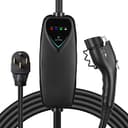
Lectron portable Level 2 charger
Lectron · J1772 · 32 A / 7.7 kW · 21 ft cable
A plug-in portable that runs at Level 2 speed from a NEMA 14-50 and drops to a standard wall outlet with the included adapter. The travel unit, not the garage unit.
What is good
- Level 2 speed from a NEMA 14-50 without an installed charger
- Falls back to a standard household outlet with the adapter
- Small enough to keep in the trunk
What is not
- 32 A ceiling, meaningfully slower than a 48 A wall unit
- Not weather-rated for permanent outdoor mounting
- Repeated plugging and unplugging wears a NEMA 14-50 receptacle faster than a hardwired unit
| Maximum output | 32 A / 7.7 kW at 240 V |
|---|---|
| Connector | SAE J1772 |
| Plug | NEMA 14-50, with an adapter for a standard outlet |
| Use | Portable. Lives in the car, not on the wall |
Skip this if: Skip it if this is your only charger and you have a garage. A wall unit is faster and does not live in your trunk.
Specifications above are the manufacturer’s published figures. Source: Lectron. We have not tested this unit — see how we pick.
FAQ
Questions people actually ask
Can you charge an electric car during a power outage?
Will my EV charger work after the power comes back?
How many miles can a home battery put into an EV?
Can my EV power my house in an outage?
Is it worth buying a generator just to charge an EV?
What should I buy to protect an EV charger from outages?
Sources
Where these numbers come from
- Electric Vehicle Charging Stations: AC Level 2 equipment — U.S. Department of Energy, Alternative Fuels Data CenterAC Level 2 equipment offers charging through 240 V (typical in residential applications) or 208 V (typical in commercial applications) electrical service. Level 2 can operate at 40 to 80 amperes and a Level 2 unit can range from 2.9 to 19.2 kW power output, adding roughly 25 miles of range per hour. Most residential Level 2 chargers operate at up to 30 A delivering 7.2 kW and require a dedicated 40 A circuit to comply with National Electrical Code Article 625. In the United States the common three-phase voltages are typically 208/120 V and 480/277 V. Read 2026-10-17.
- Charging Electric Vehicles at Home — U.S. Department of Energy, Alternative Fuels Data CenterDrivers install Level 2 (240 V) charging equipment in their homes for a faster charge, or use the Level 1 cordset provided with the vehicle. Level 2 products have standard safety features and status lights, and features such as data collection, user interfaces, enhanced displays, charging timers, communications capabilities and keypads. Read 2026-10-17.
- Enphase IQ Battery 5P — Enphase EnergyPower rating 3.84 kW, energy capacity 5.0 kWh, peak output 7.68 kW for 3 seconds and 6.14 kW for 10 seconds, DC round-trip efficiency 96%, AC round-trip efficiency 90%, LFP chemistry, 15-year limited warranty, grid-forming capability for backup operation and backup capability when installed with the IQ System Controller 3/3G. Read 2026-10-17.
- Fuel economy of 2026 Cadillac and GMC vehicles — U.S. EPA and U.S. Department of Energy, fueleconomy.govPublished consumption ratings used here: Cadillac Lyriq 37 kWh/100 mi, GMC Sierra EV 50 kWh/100 mi, GMC Hummer EV 70 kWh/100 mi (2025). Read 2026-10-11.
Read next
Related reading
- Charging an EV from a home batteryWhat a 5 kWh home battery actually gives a car, why 3.84 kW is the number that matters, and the charger setting that makes it work.
- Charging an EV from a generatorWhy most portable generators refuse to charge an EV, the fix, what it costs per mile, and the cases where it is genuinely worth it.
- Why your EV charger keeps tripping the GFCI breakerWhy GFCI breakers trip on EV chargers and the safe sequence for diagnosing it.
- Do EV chargers have built-in surge protection?What the charger makers actually publish about surge protection, and why the protection that matters sits in the panel.
- Your EV charger is not working: what to checkThe six usual causes of a charge that will not start, in the order worth checking them.