Getting started
Charging mistakes beginners make
Most of these cost money rather than safety, and every one of them is avoidable with a decision made in the right order.
By Sawyer V. · Published September 27, 2026
How this page is funded: we earn a commission if you buy through our Amazon links, at no extra cost to you. It does not change what we recommend, and we say plainly when the honest answer is to buy nothing. Full disclosure.
None of the following are exotic. They are the same handful of decisions, made in the wrong order, by people who had never bought an electrical circuit before. Working through them in the order below is most of what this site is for.
1. Buying the charger first
The panel decides what you can install. Find that out first, then buy a charger that fits the answer. A 48 A unit in a box in the garage while an electrician explains that your service is full is the worst version of this hobby. Load calculation.
2. Paying for amps the car cannot use
Your car's onboard charger sets the ceiling on AC charging. If it accepts 32 A, a 48 A charger and the 60 A circuit it needs buy you nothing at all. Look the figure up before choosing a tier. How many amps you need.
3. Measuring the cable in a straight line
The cable drops to the floor, travels around the car and rises to the port. A 12 ft straight line is comfortably a 20 ft cable path, and you cannot extend it later. Cable length.
4. Buying the cheapest 14-50 receptacle
A receptacle rated for occasional RV use is not built for 40 A, night after night. This is a small line on the quote and the most common cause of discolored, melted plug faces. The 14-50 outlet.
5. Skipping the permit
The Department of Energy notes that installations must comply with local and state codes and that permits may be required. Unpermitted electrical work surfaces at resale, and it is a conversation nobody wants with an insurer. Permits.
6. Setting charging schedules in two places
A schedule in the car and a schedule in the charger app is the classic way to wake up to an empty battery. Pick one place. Charging at night.
7. Leaving the cable on the floor
It gets driven over, and a crushed cable is the most common physical damage on a home charger. A holster and a J-hook cost very little. Cable organizers.
8. Assuming charging needs Wi-Fi
It does not. If the app cannot see the charger but the car is charging, nothing is broken. Troubleshooting.
9. Charging to 100% every night out of habit
Most cars let you set a daily limit, and the manufacturer's own guidance is in your owner's manual. It costs nothing to set once. Can you leave it plugged in.
10. Buying Level 2 before checking whether you need it
A short commute and an overnight park can be covered by the cordset that came with the car. That is a legitimate outcome, and it is the cheapest one. Do you need a Level 2 charger.
Two chargers cover most first-time buyers after that exercise: a connected 48 A unit if the panel allows it, or a plain 40 A box if you would rather own something with no software in it. Both are below.
Two safe first chargers
One connected, one deliberately not. Either suits a first installation.
1. A first charger, hardwired
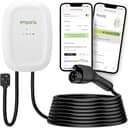
Emporia Level 2 EV Charger (Classic)
Emporia · J1772 · 48 A / 11.5 kW · 24 ft cable
The safe default for a first home charger: 48 amps hardwired, a genuinely long cable, a NEMA 4 outdoor-rated case, and no subscription attached to the app.
What is good
- 48 A hardwired is the fastest tier most homes can realistically support
- 24 ft of cable reaches across a two-car garage without a fight
- NEMA Type 4 enclosure is rated for outdoor mounting
- Energy monitoring in the app with no subscription
What is not
- Drops to 40 A if you use the NEMA 14-50 plug rather than hardwiring
- The app is the only way to change the amperage setting
| Maximum output | 48 A / 11.5 kW at 240 V (hardwired) |
|---|---|
| Plug-in output | 40 A with the NEMA 14-50 plug |
| Connector | SAE J1772 |
| Cable | 24 ft |
| Enclosure | NEMA Type 4, indoor or outdoor |
| Certification | UL listed, Energy Star |
| Warranty | 3 years |
Skip this if: Skip it if you want a unit with no app or network connection at all. The Grizzl-E Classic is the simpler machine.
Specifications above are the manufacturer’s published figures. Source: Emporia Energy. We have not tested this unit — see how we pick.
2. Harsh weather and no app
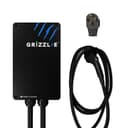
Grizzl-E Classic
United Chargers · J1772 · 40 A / 9.6 kW · 24 ft cable
A cast-aluminum box with no app, no account and no firmware to update. If you want a charger that behaves like an appliance, this is the one.
What is good
- Cast aluminum NEMA 4 / IP67 enclosure, built for outdoor mounting
- No app, no account, no network dependency
- Amperage is set with physical switches, not software
- Protections for over-current, over-voltage, ground fault and over-temperature
What is not
- 40 A ceiling, slower than the 48 A units if your panel can take more
- No scheduling, so off-peak charging has to be set in the car
- The cold-flexible 24 ft cable is only on the Extreme Edition
| Maximum output | 40 A / 9.6 kW at 240 V |
|---|---|
| Adjustable | 16, 24, 32 or 40 A |
| Connector | SAE J1772 |
| Cable | 24 ft on the Extreme Edition |
| Enclosure | Cast aluminum, NEMA 4 / IP67 |
| Certification | UL certified |
| Warranty | 3 years |
Skip this if: Skip it if you want scheduled charging or energy tracking in an app. The Classic deliberately has neither.
Specifications above are the manufacturer’s published figures. Source: United Chargers, InsideEVs. We have not tested this unit — see how we pick.
FAQ
Questions people actually ask
What is the most common EV charging mistake?
Do I need the fastest charger available?
Is it bad to charge to 100% every night?
Do I really need a permit for a home charger?
Sources
Where these numbers come from
- Charging Electric Vehicles at Home — U.S. Department of Energy, Alternative Fuels Data CenterMost drivers charge overnight at home; residential costs depend on equipment and time of day; some utilities offer time-of-use rates; outdoor use is safe with outdoor-rated equipment; smarter Level 2 units add timers and monitoring. Read 2026-09-27.
- Electric Vehicle Charging Infrastructure: charging levels and connectors — U.S. Department of Energy, Alternative Fuels Data CenterAC Level 1 about 5 miles of range per hour at 1.9 kW; AC Level 2 about 25 miles per hour, 2.9 to 19.2 kW, on J1772 or J3400 (NACS); DC fast charging about 100 to 200+ miles per 30 minutes on CCS, CHAdeMO or J3400; CCS accepts Level 1, Level 2 and DC fast charging. Read 2026-09-27.
- Emporia Level 2 EV Charger product specifications — Emporia EnergyENERGY STAR certification, app energy monitoring with no subscription.
Read next
Related reading
- Setting up home charging for the first timeThe whole home charging project in the right order, from decision to first charge.
- How to choose an EV chargerThe beginner's route to choosing a home charger: three questions, no assumed knowledge.
- How many amps do you actually need?Three checks that determine your charger amperage, and why the smallest one wins.
- How long should your EV charger cable be?How to measure your run properly, and which chargers have the longest cables.