MINI
The best home charger for a MINI EV
MINI sits inside the BMW Group, so its charging future is BMW's. Today, a J1772 charger and a short cable run cover the car in the driveway.
By Sawyer V. · Published September 23, 2026
How this page is funded: we earn a commission if you buy through our Amazon links, at no extra cost to you. It does not change what we recommend, and we say plainly when the honest answer is to buy nothing. Full disclosure.
A MINI is the kind of EV that makes the case for not overbuying. The batteries are smaller than the SUVs this category is designed around, the daily distances are usually shorter, and the car is parked at home for ten hours whatever you plug it into.
The connector
MINI's electric models have used the CCS inlet, whose top section is a J1772 inlet -- so a J1772 home charger plugs straight in with no adapter. The Department of Energy describes the same arrangement: a CCS port accepts Level 1, Level 2 and DC fast charging.
For the future: CarGurus reports that the BMW iX3 is the first BMW Group car to come standard with a NACS port, and lists the MINI Countryman SE ALL4 among the models expected to follow. It also notes the rollout slated for early 2025 was delayed, with no announcement on adapter timing since late 2024. Expected is not the same as confirmed, so the port on your own car is the fact that matters.
| Your inlet | Buy |
|---|---|
| CCS (J1772 on top) | Any J1772 Level 2 charger |
| NACS | A NACS charger, a dual-connector unit, or J1772 plus an adapter |
| Not sure | Look at the car before ordering |
Why 40 amps is usually enough
A 40 A charger delivers about 9.6 kW, which the Department of Energy's rule of thumb puts at roughly 25 to 35 miles of range an hour depending on the car. For a compact EV doing normal commuting distances, that refills a day's driving in an hour or two and a nearly empty battery overnight.
An ordinary week
40 A x 240 V = 9.6 kW
Two hours plugged in = about 19 kWh
That is a normal daily commute replaced before dinner
A 48 A charger would do the same job about 20% faster, on a bigger circuit
The exception is the household where the MINI shares the charger with a large EV or a truck. There, the bigger vehicle sets the requirement. Chargers for two EVs covers sharing.
What to look for
- Cable reach to the port with the car parked normally -- the most common regret. Cable length.
- A plug-in unit if you may move house or take it with you. Plug-in chargers.
- An outdoor rating if it lives on a driveway wall.
- An app, or deliberately none -- the car can schedule charging either way. Charging at night.
The picks
The Emporia Classic is the safe default: 48 A hardwired or 40 A on a plug, a 24 ft cable and ENERGY STAR certification, so it still suits the next, larger EV. The Grizzl-E Classic is the choice if you would rather have no app and no account at all, in a cast-aluminum case that shrugs off an exposed wall. The Tesla Universal Wall Connector is the one to consider only if a NACS car is also in the household.
Chargers for a MINI EV
Two J1772 units, and a dual-connector unit for a mixed-port household.
1. A first charger, hardwired
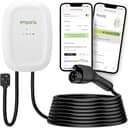
Emporia Level 2 EV Charger (Classic)
Emporia · J1772 · 48 A / 11.5 kW · 24 ft cable
The safe default for a first home charger: 48 amps hardwired, a genuinely long cable, a NEMA 4 outdoor-rated case, and no subscription attached to the app.
What is good
- 48 A hardwired is the fastest tier most homes can realistically support
- 24 ft of cable reaches across a two-car garage without a fight
- NEMA Type 4 enclosure is rated for outdoor mounting
- Energy monitoring in the app with no subscription
What is not
- Drops to 40 A if you use the NEMA 14-50 plug rather than hardwiring
- The app is the only way to change the amperage setting
| Maximum output | 48 A / 11.5 kW at 240 V (hardwired) |
|---|---|
| Plug-in output | 40 A with the NEMA 14-50 plug |
| Connector | SAE J1772 |
| Cable | 24 ft |
| Enclosure | NEMA Type 4, indoor or outdoor |
| Certification | UL listed, Energy Star |
| Warranty | 3 years |
Skip this if: Skip it if you want a unit with no app or network connection at all. The Grizzl-E Classic is the simpler machine.
Specifications above are the manufacturer’s published figures. Source: Emporia Energy. We have not tested this unit — see how we pick.
2. Harsh weather and no app
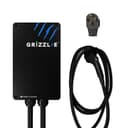
Grizzl-E Classic
United Chargers · J1772 · 40 A / 9.6 kW · 24 ft cable
A cast-aluminum box with no app, no account and no firmware to update. If you want a charger that behaves like an appliance, this is the one.
What is good
- Cast aluminum NEMA 4 / IP67 enclosure, built for outdoor mounting
- No app, no account, no network dependency
- Amperage is set with physical switches, not software
- Protections for over-current, over-voltage, ground fault and over-temperature
What is not
- 40 A ceiling, slower than the 48 A units if your panel can take more
- No scheduling, so off-peak charging has to be set in the car
- The cold-flexible 24 ft cable is only on the Extreme Edition
| Maximum output | 40 A / 9.6 kW at 240 V |
|---|---|
| Adjustable | 16, 24, 32 or 40 A |
| Connector | SAE J1772 |
| Cable | 24 ft on the Extreme Edition |
| Enclosure | Cast aluminum, NEMA 4 / IP67 |
| Certification | UL certified |
| Warranty | 3 years |
Skip this if: Skip it if you want scheduled charging or energy tracking in an app. The Classic deliberately has neither.
Specifications above are the manufacturer’s published figures. Source: United Chargers, InsideEVs. We have not tested this unit — see how we pick.
3. A two-car, two-connector garage
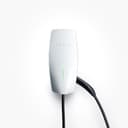
Tesla Universal Wall Connector
Tesla · J1772 + NACS · 48 A / 11.5 kW · 24 ft cable
The Wall Connector with a J1772 adapter built into the holster, so it charges a Tesla and a non-Tesla without anything loose to lose.
What is good
- Charges NACS and J1772 cars without a separate adapter to store
- Same 48 A output and four-year warranty as the Gen 3
- The adapter docks in the holster, so it cannot walk off
What is not
- Costs more than the NACS-only Gen 3
- Hardwired only
| Maximum output | 48 A / 11.5 kW at 240 V |
|---|---|
| Connector | NACS with an integrated J1772 adapter |
| Cable | 24 ft |
| Installation | Hardwired |
| Warranty | 4 years |
Skip this if: Skip it if both cars use the same connector. You are paying for an adapter you do not need.
Specifications above are the manufacturer’s published figures. Source: Tesla. We have not tested this unit — see how we pick.
FAQ
Questions people actually ask
Can I use a J1772 charger on a MINI Countryman SE?
Is MINI switching to NACS?
Do I need a 48 amp charger for a MINI?
Is a portable charger enough for a MINI?
Sources
Where these numbers come from
- All the EVs that use Tesla's NACS plug — CarGurusBMW Group section: the iX3 is the first BMW with a standard NACS port and its adapter will be for CCS; the i4, i5, iX, i7, MINI Countryman SE ALL4 and Rolls-Royce Spectre are expected to follow; the rollout slated for early 2025 was delayed, with no announcement on adapter timing since late 2024. Read 2026-09-23.
- Electric Vehicle Charging Infrastructure: AC Level 2 equipment — U.S. Department of Energy, Alternative Fuels Data CenterAC Level 2 runs at 240 V in homes, adds roughly 25 miles of range per hour of charging, and uses the J1772 or J3400 (NACS) connector. The CCS inlet accepts Level 1, Level 2 and DC fast charging. Read 2026-09-23.
Read next
Related reading
- The best home charger for a BMW EVA J1772 charger for a CCS inlet, and what BMW's NACS switch on the iX3 means for the rest.
- J1772 home charging: what it is and who needs itWhat J1772 is, which cars use it, and why it remains the most versatile choice.
- The best 40-amp EV chargersWhy 40 A is the sweet spot for most homes, and the units that do it well.
- EV charging adapters, sorted outWhich charging adapters you need, which came free with the car, and the safety rules.