Two EVs
Adding a second EV charger
The second car rarely needs a second circuit. It needs a plan for dividing the one you already have.
By Sawyer V. · Published September 27, 2026
How this page is funded: we earn a commission if you buy through our Amazon links, at no extra cost to you. It does not change what we recommend, and we say plainly when the honest answer is to buy nothing. Full disclosure.
The second EV arrives and the charging plan that worked for a year suddenly has a queue in it. Before spending anything, work out whether you have a power problem or a convenience problem -- they have different answers.
First: do you actually need more power?
What one 40 A charger delivers overnight
40 A x 240 V = 9.6 kW
Ten hours parked = up to 96 kWh
Two cars driving 40 miles a day need roughly 24 kWh between them
The constraint is usually the cable, not the kilowatt-hours
Most two-EV households are not short of energy overnight. They are short of patience for moving a cable at 11 pm. That distinction decides which of the routes below is worth paying for.
The four routes
| Route | Speed per car | Asks of your panel |
|---|---|---|
| Keep one charger, take turns | Full speed, one at a time | Nothing |
| Two-cable charger (Grizzl-E Duo Connect) | Split when both plugged in | One existing 14-50 circuit |
| Two chargers, power sharing | Split, managed in software | One circuit, two installations |
| Two chargers, two circuits | Full speed each | Two circuits, and the capacity for both |
What the code allows
The default rule is that each charger takes its own branch circuit, under NEC 625.42. The exception is an approved energy management system, and NEC 2023 specifically allows multiple chargers to share a single branch circuit through one. That exception is what power sharing is built on. Does a charger need its own circuit.
In practice this means the honest question for your electrician is not "can I have two chargers" but "can this service carry two chargers, and if not, which sharing arrangement will you sign off on?"
When the panel is the problem
- A load-managed charger can let an existing service take the second car without new panel hardware. Load management.
- A subpanel adds breaker spaces but not capacity. Subpanels.
- A service upgrade is the expensive last resort. Panel upgrades.
- Charging one car at a lower current is free, and frequently enough. Most chargers adjust.
The order to work through it
- Measure the real need: what each car uses on a normal day, not the battery size.
- Try taking turns for two weeks. It is free, and it settles whether this is a convenience problem.
- Get a load calculation before choosing hardware. Load calculation.
- Price all four routes, including the do-nothing one.
- Decide on cable reach too -- a second bay two feet out of range is its own problem. Where to mount.
Two ways to add the second car
A load-managed charger for a tight panel, or one plug-in charger with two cables.
1. A tight panel
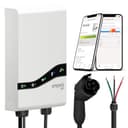
Emporia Pro EV Charger
Emporia · J1772 · 48 A / 11.5 kW · 25 ft cable
Emporia's 48-amp charger with PowerSmart load management built in: the Vue 3 energy monitor comes in the box, and the charger backs off when the rest of the house is busy. The one to look at when your panel is the obstacle.
What is good
- PowerSmart load management included, not an add-on
- Vue 3 energy monitor in the box, for whole-home data
- Emporia says it works even with older 60 or 100 amp services
- J1772 or NACS connector options
What is not
- PowerSmart needs the Vue installed in your panel -- electrician work
- Costs more than the Emporia Classic, which charges at the same 48 A
- Only worth it if your panel is the constraint
| Maximum output | 48 A hardwired; 40 A with a NEMA plug |
|---|---|
| Connector | J1772 or NACS, chosen at purchase |
| Cable | 25 ft |
| Load management | PowerSmart, standard |
| In the box | Emporia Vue 3 energy monitor |
| Installation | NEMA 14-50 plug or hardwired; rear-entry option |
| Certification | UL certified, GFCI-protected |
| Warranty | 3 years |
Skip this if: Skip it if your panel has comfortable room for a full EV circuit. Without that problem you are paying for load management you will not use -- the Emporia Classic charges at the same 48 A.
Specifications above are the manufacturer’s published figures. Source: Emporia Energy, Emporia Energy, Classic vs Pro, Emporia Energy, store. We have not tested this unit — see how we pick.
2. Two EVs on one circuit
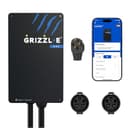
Grizzl-E Duo Connect
United Chargers · J1772 · 40 A / 9.6 kW · 25 ft cable
Two 25 ft cables on one 40 A plug-in charger, so two EVs can be plugged in at once. The honest catch is in the maker's own spec: 40 A total, and 20 A each when both cars charge together.
What is good
- Two cars can stay plugged in on one 50 A circuit, with no swapping cables at midnight
- Two 25 ft cables, the longest on this site, so both bays are reachable
- Connector pairs to suit a mixed household: J1772/J1772, J1772/NACS or NACS/NACS
- UL/cUL listed with a published file number, and a UL Type 4 indoor/outdoor rating
- Wi-Fi scheduling and statistics in the Grizzl-E Connect app, with an indicator light per connector
What is not
- 40 A is the total, not per car: United Chargers lists 20 A each when two vehicles charge at once
- Plug-in only at 40 A, so there is no 48 A hardwired version
- Costs far more than one Classic Connect, which gives a single car the full 40 A
- Two-car households that charge at different times gain nothing over a single charger
- 2.4 GHz Wi-Fi only, like the rest of the Connect range
| Maximum output | 40 A total (the maker lists 10 kW) |
|---|---|
| With two cars charging | 20 A each, per United Chargers |
| Adjustable | 40 A down to 16 A |
| Connectors | Two: J1772/J1772, J1772/NACS or NACS/NACS |
| Cables | Two, 25 ft (7.6 m) each |
| Plug | NEMA 14-50 |
| Enclosure rating | UL Type 4, indoor and outdoor |
| Operating temperature | -30 C to +50 C (-22 F to 122 F) |
| Enclosure size | 10.25 x 6.25 x 3.75 in |
| Weight | 26.46 lb (12 kg) |
| Connectivity | Wi-Fi (2.4 GHz) and the Grizzl-E Connect app |
| Certification | UL/cUL, file E510712 |
| Warranty | 3 years, or 5 years chosen at purchase |
Skip this if: Skip it if only one car charges at a time, or if either car needs the full 40 A overnight. One Classic Connect costs far less and gives that car everything the circuit has.
Specifications above are the manufacturer’s published figures. Source: United Chargers. We have not tested this unit — see how we pick.
FAQ
Questions people actually ask
Can two EV chargers share one circuit?
Do I need a second circuit for a second EV?
Is a two-cable charger as good as two chargers?
What if my panel cannot take another circuit?
Sources
Where these numbers come from
- NEC Article 625: EV charging equipment — WireRef625.41 continuous load rated at 125%, 625.42 dedicated branch circuit and the energy-management exception allowing multiple chargers to share one circuit, 625.54 GFCI protection. Read 2026-09-27.
- Emporia Pro EV Charger — Emporia EnergyPowerSmart load management and the Vue 3 monitor included in the box.
- Grizzl-E Duo Connect 40A — United ChargersTwo 25 ft cables from one plug-in charger, 40 A total with 20 A each when two vehicles charge.
- Wall Connector support page — TeslaPower sharing across as many as six linked Wall Connectors on one circuit.
Read next
Related reading
- The best EV chargers for a two-EV householdCharging two EVs at home: taking turns, power sharing, or two circuits.
- Grizzl-E Duo Connect vs Tesla Wall ConnectorOne charger with two cables against two linked chargers sharing a circuit. Which fits two EVs.
- Load management: charging without a panel upgradeHow load management avoids a panel upgrade, what it costs in speed, and when to use it.
- Does an EV charger need its own circuit?The dedicated-circuit rule, the energy-management exception, and what it means for your panel.