Cable protection
The best EV charging cable protector when the cable has to cross the floor
If your charging cable runs across a driveway, a walkway or under a closing garage door, the cord-cover aisle is mostly the wrong size for it. One published number tells you which products can even be considered.
By Sawyer V. · Published November 7, 2026
How this page is funded: we earn a commission if you buy through our Amazon links, at no extra cost to you. It does not change what we recommend, and we say plainly when the honest answer is to buy nothing. Full disclosure.
The verdict, in one line: if the cable genuinely has to lie on the floor, buy the Design Engineering EV Charge Cord Protector -- a 20-foot split sleeve sold against a published fitment of 3/4 to 1 inch, which is the only spec in this category that matches what an EV cable actually measures. If you have a wall near where the car parks, spend the same money on a BARKAN 32-inch cable arm instead and the cable never touches the ground again. And if the cable only ends up on the floor because the connector has nowhere to live, a twenty-dollar holster and J-hook fixes it completely.
Cable protection picks
Ranked for a first home charger. Every row jumps to the full write-up below.
| # | Product | Best for | Max output | Price |
|---|---|---|---|---|
| 1 |  DEI EV Charge Cord Protector (10680)A cable that gets driven over, scraped or shut in a door. Cable accessory, 20 ft cable. | A cable that gets driven over, scraped or shut in a door | — | $82.19 · View on Amazon#ad how we are funded · price as of November 8, 2026 |
| 2 |  BARKAN 32 in / 80 cm protective EV charging cable wall arm (EV80WM)A single parking space, charger on the same wall. Cable accessory. | A single parking space, charger on the same wall | — | $63.92 · View on Amazon#ad how we are funded · price as of November 8, 2026 |
| 3 |  Lectron J1772 holster dock and J-hookJ1772 connectors. J1772. | J1772 connectors | — | $19.99 · View on Amazon#ad how we are funded · price as of November 8, 2026 |
| 4 | Lectron J1772 charger holder setPortable chargers. J1772. | Portable chargers | — | |
| 5 |  Legrand Wiremold Corduct 5 ft overfloor cord protector (CDI-5)A 120 V Level 1 cord crossing a walkway. Cable accessory, 5 ft cable. | A 120 V Level 1 cord crossing a walkway | — | $12.10 · View on Amazon#ad how we are funded · price as of November 8, 2026 |
Why the cord-cover aisle does not fit
This is the part nobody writes down. Walk into a hardware store, ask for a cord cover, and you will be handed a product designed for a lamp flex or a network cable. Legrand's Corduct, which is the brand-name version with an actual specification sheet, is described by Legrand itself as a raceway "designed for use in protecting electrical cords and low voltage wiring and cabling" and is stated on the same page to be not NRTL listed. It is a good product. It is not a product for the thing you are trying to protect.
The two makers who do publish a figure for an EV cable are the ones who had to. BARKAN specifies its cable arms as "compatible with mobile and station charging cables with a diameter of up to 0.7 in / 18 mm". Design Engineering sells its sleeve as fitting "3/4 to 1 diameter charger cables". So the working range is roughly 0.7 to 1.0 inch, which is between two and three times the channel of a domestic cord cover.
| Item | Published figure | Source | What it means for you |
|---|---|---|---|
| A Level 2 charging cable | Up to 0.7 in / 18 mm | BARKAN, arm fitment | The upper limit their arms will take -- a useful floor for what a cable measures |
| An EV charge cord | 3/4 in to 1 in | Design Engineering, sleeve fitment | The range their sleeve is sold for, which brackets the thick 48 A cords |
| A DC fast-charging cable | 1 in to 2 in / 26-50 mm | BARKAN, DC arm fitment | Not your problem at home, but it shows how wide the category runs |
| A domestic floor cord cover | Cords and low-voltage cabling; not NRTL listed | Legrand, Corduct | Sized for a lamp flex. Fine for a Level 1 cord, wrong for Level 2 |
The one that fits: a split sleeve
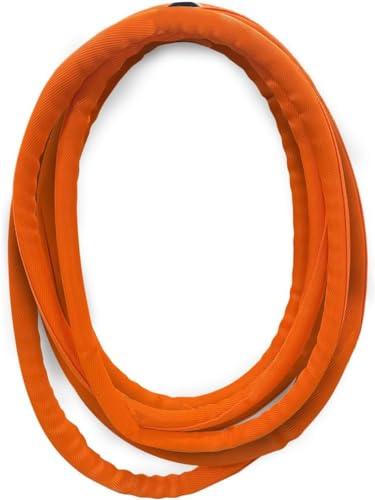
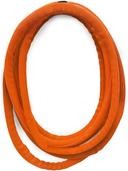
A sleeve is a different idea from a cover. A cover is a ramp that sits over the cable and protects the floor traffic; a sleeve wraps the cable and protects the cable. For a home charging cable the second is the thing you want, because the cable is the expensive part and it is the part that gets scuffed, pinched and frozen. The DEI sleeve is split along its length, so it goes on a cable that is already installed -- no unplugging, no electrician, no rewiring -- and DEI publishes two flammability test results for it rather than none.
The better answer: do not let it reach the floor
Every winter page on this site arrives at the same conclusion from a different direction. A cable coiled on a garage floor sits in meltwater, freezes into whatever shape it cooled in, gets stepped on and gets caught by a snow shovel. Your winter EV charging kit ranks the wall holster first for exactly that reason, and a frozen charge port is what happens when the connector face lives in the wet.
So before you buy armor, price the alternative. A holster and a J-hook is about twenty dollars and takes ten minutes. A cable wall arm lifts the whole cable above head height and routes it inside the arm, which is a complete answer rather than a mitigation. Both are cheaper than replacing a damaged cable, and neither leaves anything on the ground to drive over.
The garage-door question, answered honestly
The most common search in this cluster is some version of running the cable under a closed garage door. It is worth being blunt: do not. A sectional door closes with real force onto a strip that is designed to seal against a flat floor, and a charging cable under it is both a pinch point on a live 240 V conductor and a permanent gap for water, grit and mice. The purpose-built thin "pass-through" guards sold for this are marketplace-brand products with no maker record we can check, which is why none of them is ranked here.
The real fixes are all boring. Put the charger on the outside wall and accept that it lives outdoors -- every charger on this site with a published NEMA 4 or Type 4 rating is built for that, and the best outdoor EV charger ranks on that rating. Or have the electrician run the circuit to where the car actually parks; outdoor EV charger installation covers what that costs. Or, if the car parks just outside the door, a 63-inch wall arm mounted inside will often reach over the top of the door track.
Where the Legrand part does belong
It is on this page as a ranked pick rather than a warning box because there is a real job for it: a Level 1 cord. The 120 V cord that came with the car is a fraction of the diameter of a Level 2 cable, and in a lot of households that cord is the whole charging setup -- the Department of Energy puts Level 1 at roughly 5 miles of range per hour, which covers a short commute overnight. If that cord crosses a walkway in a garage, a Corduct run with the tape that comes in the box is the correct, cheap, branded answer. The best outlet for Level 1 charging is the other half of that setup.
The five, in order
1. A cable that gets driven over, scraped or shut in a door
DEI EV Charge Cord Protector (10680)
Design Engineering · Cable accessory · 20 ft cable
The only cable protector we found that is sold against a published EV cable diameter: a 20-foot split sleeve for cords 3/4 to 1 inch thick. It protects the cable itself rather than the floor, which is the right way round for a cable that moves every day.
What is good
- Sold against a published cable diameter, which almost nothing in this category is
- Split design wraps a cable that is already installed -- no unplugging, no rewiring
- 20 ft covers the run of a typical 25 ft charging cable where it matters
- Passes two published flammability tests rather than none
- Adds visibility to a black cable on a dark garage floor
What is not
- Protects the cable, not the floor -- it is not a trip-free ramp
- No warranty term published on the page we read
- Adds diameter, so a tight holster or a narrow cord channel may no longer fit
- Does nothing about the cable's weight, which is the other half of the problem
| Length | 20 ft |
|---|---|
| Fits cable diameter | 3/4 in to 1 in |
| Design | Split sleeve -- wraps an installed cable without unplugging it |
| Flammability | Passes UL94 and FMVSS302, per DEI |
| Part number | 10680 |
| UPC | 607078106803 |
| In the box | One cord protector sleeve |
Skip this if: Skip it if your cable never leaves a wall hook -- a sleeve solves abrasion, not storage. Skip it too if what you want is a trip-free surface across a walkway; a sleeve adds bulk rather than a ramp.
Specifications above are the manufacturer’s published figures. Source: Design Engineering, Inc.. We have not tested this unit — see how we pick.
2. A single parking space, charger on the same wall
BARKAN 32 in / 80 cm protective EV charging cable wall arm (EV80WM)
BARKAN · Cable accessory
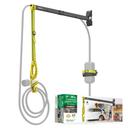
The cheapest honest answer to a cable on the floor: a zinc-coated arm that lifts the cable above head height, hides most of it inside the arm, and comes with a wall holder for a portable charger's control box. BARKAN publishes the cable diameter it fits, which is the number that decides whether any of this works.
What is good
- Publishes the cable diameter and cable weight it is rated for -- almost nothing in this category does
- Routes most of the cable inside the arm, so it is a conduit rather than just a hook
- Ships with a wall holder for a portable charger's control box, usually a separate purchase
- 5-year warranty, and the coating is specified for rain and sun rather than described as weatherproof
- Adjustable handle doubles as the handle store and the cable coil
What is not
- 0.7 in diameter limit rules out the thickest 48 A cables -- measure yours first
- 11 lb cable limit is a real ceiling on a long heavy cord
- Needs a solid wall or beam; drywall alone is not on BARKAN's list
- A post adapter for metal poles is sold separately
- At 32 inches it is the short one; a car parked wide needs the longer arm
| Maximum distance from the wall | 32 in / 80 cm |
|---|---|
| Fits cable diameter | Up to 0.7 in / 18 mm |
| Cable weight supported | 11 lb / 5 kg; safety tested at 44 lb / 20 kg |
| Recommended installation height | 91 in / 230 cm |
| Mounting surfaces | Block, concrete, wooden beams, or a square wooden post at least 4 in / 10 cm |
| Weather | Indoor and outdoor; zinc coating plus UV additives |
| In the box | Disassembled arm, adjustable handle, strap, a wall holder for the control box, screws and anchors |
| Warranty | 5 years |
| Color | Black |
Skip this if: Skip it if your cable is thicker than 0.7 in or heavier than 11 lb -- BARKAN publishes both limits. Skip this length if the car parks more than a yard out from the wall; the 63-inch arm exists for that.
Specifications above are the manufacturer’s published figures. Source: BARKAN Mounts. We have not tested this unit — see how we pick.
3. J1772 connectors
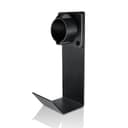
Lectron J1772 holster dock and J-hook
Lectron · J1772
A steel dock that latches a J1772 connector and a hook for the cable, rated by Lectron for indoor and outdoor use. Fits all J1772 connectors.
What is good
- Anti-corrosive steel rather than plastic
- Latches the connector so it stays put
- Hook keeps the cable off the ground
What is not
- J1772 only
- No holder for a portable's control box -- see the holder set
- Check your charger does not already have a holster
| Fits | All J1772 connectors |
|---|---|
| Material | Anti-corrosive steel |
| Use | Indoor or outdoor |
| In the box | Dock and J-hook, with mounting hardware |
Skip this if: Skip it if your connector is a Tesla (NACS) -- this dock is shaped for J1772.
Specifications above are the manufacturer’s published figures. Source: Lectron. We have not tested this unit — see how we pick.
4. Portable chargers
Lectron J1772 charger holder set
Lectron · J1772
A connector dock plus an adjustable holder that clamps a portable charger's control box to the wall -- most of what a wall unit gives you, for a portable that lives on a 14-50.
What is good
- Holds the portable's control box as well as the connector
- Adjustable arms fit different box widths
- Keeps a portable off the floor between trips
What is not
- J1772 only
- Plastic rather than steel
- Only useful if the portable stays mounted at home
| Fits | J1772 portable chargers, Level 1 or 2 |
|---|---|
| Box holder | Adjustable side arms to fit the control box |
| Material | ABS plastic |
| In the box | Box holder, connector holder, 7 mounting screws |
Skip this if: Skip it if you have a wall-mounted charger with its own holster; this set is built around a portable's control box.
Specifications above are the manufacturer’s published figures. Source: Lectron. We have not tested this unit — see how we pick.
5. A 120 V Level 1 cord crossing a walkway
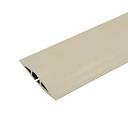
Legrand Wiremold Corduct 5 ft overfloor cord protector (CDI-5)
Legrand · Cable accessory · 5 ft cable
A real brand's cord protector with a real spec sheet -- and the spec sheet is why it belongs on a Level 1 cord and nowhere near a Level 2 cable. Legrand states plainly that Corduct is not NRTL listed and is only for protecting electrical cords and low-voltage cabling.
What is good
- A published specification sheet and a named warranty, which the marketplace cord covers do not have
- Cuts to length with a knife, so one piece covers an awkward run
- Tape is in the box and it goes down in minutes
- The correct, cheap answer for a Level 1 cord left across a walkway
What is not
- Too small for a Level 2 charging cable -- that is a warning, not a quibble
- Not NRTL listed, and Legrand says so on its own page
- Tape on hardwood is a residue risk
- Ships coiled and wants flattening under weight before it will lie down
| Length | 60.0 in (5 ft) |
|---|---|
| Weight | 0.665 lb |
| Fixing | Pressure-sensitive tape, included |
| Cut to length | Scissors or a utility knife |
| Listing | Not NRTL listed, per Legrand |
| Intended use | Electrical cords and low-voltage wiring and cabling |
| RoHS | Compliant |
| Catalog number | CDI-5 (ivory); CDB-5, CDG-5 and CDBK-5 are the other colors |
| UPC | 086698870118 |
Skip this if: Skip it for a Level 2 cable. The makers that publish a figure put a charging cable at 0.7 to 1 inch across, and this is a small-cord channel. Skip it on hardwood too -- Legrand fixes it with pressure-sensitive tape.
Specifications above are the manufacturer’s published figures. Source: Legrand, Wiremold. We have not tested this unit — see how we pick.
How we picked, and what we did not rank
We searched the category and found plenty of purchasable products: thin silicone garage-door guards at $15, rubber drive-over ramps rated in pounds per axle, and polyurethane cable protectors from the industrial side of the market. Most of the EV-specific ones are unbranded marketplace listings -- a name that exists only as a seller account, with no company website, no specification table and no warranty. For a rubber ramp that matters less than it would for a charger, but it matters: we could not tell you what channel size any of them actually has, and channel size is the only question on this page.
Two industrial brands in the category -- Checkers and Electriduct -- do publish real specifications, and their heavy ramps would physically take a charging cable. Their own websites were not reachable from here on 2026-11-07, so we have no maker record to cite and have not ranked them. That is the same standard this site applied to unbranded pedestals and to cheap marketplace chargers.
FAQ
Questions people actually ask
How thick is an EV charging cable?
Can I use a normal floor cord cover for my EV charging cable?
Is it safe to run a charging cable under a garage door?
Does a cable sleeve make charging slower or hotter?
What is the cheapest way to stop the cable ending up on the floor?
Sources
Where these numbers come from
- EV Charge Cord Protector (part 10680) — Design Engineering, Inc.Split sleeve designed to wrap around an electric vehicle charge cord; fits 3/4 to 1 diameter charger cables and comes in 20 ft length; passes UL94 and FMVSS302 flammability tests; part number 10680, UPC 607078106803. Read 2026-11-07.
- Corduct 5' Overfloor Cord Protector, Ivory (CDI-5) — Legrand, WiremoldConceals wires and cords while creating a smooth, trip-free surface; applies to any flooring surface with pressure-sensitive tape included; cuts to any length with scissors or a utility knife; length 60.0 in; weight 0.665 lb; warranty 1 year from installation or 2 years from day of sale. Legrand states: "Raceway is not NRTL Listed and is only designed for use in protecting electrical cords and low voltage wiring and cabling." Read 2026-11-07.
- 32 in / 80 cm Protective EV Charging Cable Wall Arm (EV80WM) — BARKAN MountsLifts the cable above head height, concealing most of it inside the mount, which serves as a cable conduit. Supports cables weighing up to 11 lbs / 5 kg; safety tested with a load of 44 lbs / 20 kg. Maximum distance from the wall 32 in / 80 cm. Compatible with mobile and station charging cables with a diameter of up to 0.7 in / 18 mm. Mounts on block, concrete or wooden beams, or a square wooden pergola post of at least 4 in / 10 cm. Recommended installation height 91 in / 230 cm. Package includes a wall-mounted holder for the control box, screws and anchors, the disassembled mount, an adjustable handle and a strap. 5-year warranty. Read 2026-11-07.
- Electric Vehicle Charging Infrastructure: charging levels — U.S. Department of Energy, Alternative Fuels Data CenterAC Level 1 uses a 120 V household outlet and adds roughly 5 miles of range per hour of charging, assuming 1.9 kW. AC Level 2 equipment offers charging through 240 V (typical in residential applications) or 208 V (typical in commercial applications) service, can range from 2.9 to 19.2 kW output, and adds roughly 25 miles of range per hour. Read 2026-11-07.
- Lectron J1772 EV charger nozzle holster dock and J-hook — LectronHolster dock and J-hook for a J1772 connector, indoor or outdoor mounting, supplied with screws and wall plugs.
Read next
Related reading
- The best EV charging cable wall armCable arms by reach, the 0.7 in and 11 lb limits that decide fitment, and what to do when there is no wall at all.
- The best EV charger holsters and cable organizersHolsters and hooks that keep the connector off the floor and the cable out from under the wheels.
- Your winter EV charging kitFive winter purchases in priority order, plus the four habits that matter more than any of them.
- Outdoor EV charging: what needs a coverWhy a plug-in outdoor install needs an extra-duty 2-gang while-in-use cover, why a 1-gang bubble cover will not fit, and what the charger itself needs.