Charger review
Enphase IQ EV Charger 2 review
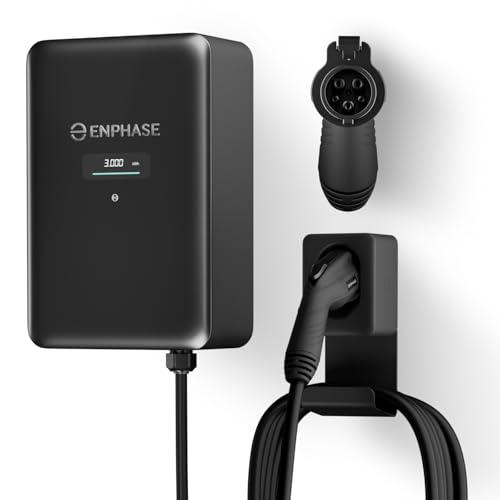
Most chargers make you pick a connector and live with it for a decade. This one is sold with replaceable J1772 and NACS cables -- which, on a site that has spent a year writing about adapters, is the specification worth reading.
By Sawyer V. · Published November 10, 2026
How this page is funded: we earn a commission if you buy through our Amazon links, at no extra cost to you. It does not change what we recommend, and we say plainly when the honest answer is to buy nothing. Full disclosure.
The verdict: if you are buying a charger now and expect to still own it when your next car arrives with a different plug, this is the one to look at, because Enphase is the only maker on this site that publishes a replaceable cable as a feature rather than a repair. Everything else it does well -- the -40 F rating, the NEMA 4 case, the revenue-grade meter, the five-year warranty -- is a reason to keep it on the shortlist rather than a reason to buy it on its own. And the reason to walk away is simple and worth saying first: this is the most expensive 48 A charger on this site, and a meaningful part of that price buys integration with an Enphase solar and battery system. If you do not have one and are not getting one, the best home EV chargers has cheaper units that put the same amps on the wall.
The charger
Ranked for a first home charger. Every row jumps to the full write-up below.
| # | Product | Best for | Max output | Price |
|---|---|---|---|---|
| 1 |  Enphase IQ EV Charger 2 (48 A hardwired)A charger you expect to outlive the connector. J1772 + NACS, 25 ft cable. | A charger you expect to outlive the connector | 48 A11.5 kW | $899.20 · View on Amazon#ad how we are funded · price as of November 10, 2026 |
Why the replaceable cable is the story
This site has spent the last year writing about one slow-motion problem: North America is changing its charging connector, and it is doing it car by car rather than all at once. Hyundai flipped the Ioniq 5 to a native NACS port at the 2025 model year while the Ioniq 5 N stayed on CCS. GM flipped Chevrolet and GMC at 2027 while Cadillac's published fitment still runs CCS1 through 2027. Households end up with one NACS car and one J1772 car in the same garage, and the usual answers are an adapter hanging off the connector forever or a second charger.
A charger bolted to a wall and wired into a 60-amp circuit is a ten-year object. The connector on the end of its cable is not. Enphase's answer is to decouple the two: the product page states that the J1772 and NACS cables are "easily replaceable" and "compatible with all EVs in North America". That is a different theory of the problem from everyone else's, and it is the one that survives the next decade best.
The three models, and which one you want
| Model | Output | Connection | Best for | Who should skip it |
|---|---|---|---|---|
| IQ EV Charger 2, hardwired 48 A, J1772 | Up to 11.5 kW | Hardwired, bottom or rear entry | Most households -- J1772 is still the mainstream connector | A NACS-only garage, which should take the NACS cable instead |
| IQ EV Charger 2, hardwired 48 A, NACS | Up to 11.5 kW | Hardwired, bottom or rear entry | A Tesla or any native-NACS car, with no adapter in the routine | A J1772 household -- the cable is replaceable, but buy the right one first |
| IQ EV Charger 2, 40 A, NEMA 14-50 plug | Up to 9.6 kW | Plugs into a NEMA 14-50 | Renters, and anyone who wants to take it when they move | Anyone whose panel can feed 60 A and who wants the extra 8 amps |
The plug-in model is the interesting third option and it is easy to overlook. Forty amps on a NEMA 14-50 is the same tier as most plug-in chargers on this site, it needs no electrician if a correctly wired 14-50 already exists, and it is the only version of this charger you can unplug and take with you. Hardwired vs plug-in is the full version of that trade; taking your EV charger with you is the moving-house case.
What 48 amps actually gets you
Range per hour, worked out
Output in kW = amps x 240 V / 1,000. So 48 A = 11.5 kW and 40 A = 9.6 kW.
Miles per hour = kW / (your car's kWh per 100 miles) x 100.
An efficient sedan at 28 kWh/100 mi: 11.5 / 28 x 100 = about 41 miles of range per hour.
An electric pickup at 50 kWh/100 mi: 11.5 / 50 x 100 = about 23 miles per hour.
The 40 A plug-in model gives about 34 and about 19 miles per hour on the same two cars.
Enphase's own page quotes 34 to 77 miles of range per hour, assuming an average EV efficiency of 3.6 mi/kWh. Our arithmetic above uses kWh per 100 miles because that is the figure the EPA publishes per car, and it lands lower on a heavy vehicle. Both are honest; the difference is the assumed car. The practical point is the one this site keeps making in how many amps do you need: over a ten-hour night, 48 amps and 40 amps both finish the job for almost everyone, and the amperage you can actually use is capped by your car's onboard charger.
One thing worth noting honestly: Enphase's feature list says the product "delivers up to 19.2 kW with adjustable settings", while its own US model table tops out at 11.5 kW. Those are not the same claim. The 19.2 kW figure appears to describe the range rather than the North American home units, so the figure that applies to what you can buy here is 11.5 kW. We have flagged it rather than quietly picking the bigger number.
The circuit, and the panel-upgrade claim
A 48-amp charger is a continuous load, so the branch circuit has to be rated at 125% of it -- 60 amps. That is the line on the quote that turns a cheap install into an expensive one, because a full panel means a subpanel or a service upgrade. Enphase meets this head-on: it says built-in load balancing "adjusts power draw in real time" and presents it as the way to "skip the $3-5k electrical panel upgrade".
That is a real feature and this site rates it highly -- the best EV charger with load management exists because it is often the difference between a $600 install and a $4,000 one. Two caveats. Load balancing manages the charger's draw against the rest of the house; it does not change what your panel is rated for, and whether it satisfies your inspector is a local question. And the dollar range in that claim is Enphase's, not ours: our own figures live on EV charger installation cost. Work through the electrical panel load calculation before you assume either number applies to your house.
Weather, metering and the things nobody publishes
Two specifications here are genuinely unusual, and both are the kind this site rewards because most makers stay silent on them.
- Temperature: tested from -40 F to 131 F. That is the widest published range of any charger in this registry -- the Grizzl-E units publish -22 F, and several rivals publish nothing at all. Enphase adds 10,000 hours of damp-heat power testing and thermal protection in direct sunlight. If the charger lives outside in a cold climate, this is the number to shop on; the best EV charger for cold climates ranks the field on exactly that.
- Metering: a revenue-grade meter, plus or minus 1%. Almost nothing in the home category publishes an accuracy figure. It matters in two situations -- billing a tenant or a houseguest, and documenting consumption for a utility rebate. EV charger for a rental property is where that argument lands.
- Enclosure: NEMA 4, fully weather-sealed, with surge protection, ground fault, and a seismic and tilt sensor. EV charger safety certifications explains why a NEMA rating and a UL listing are separate things, and why you want both.
- Access control: app-based or RFID. The same job the Autel 80A does with a card reader, on a unit you are more likely to put on a shared driveway. Best EV charger with access control.
- Warranty: five years. Two years longer than the three-year standard across most of this field, and matching the HCS-80.
How it compares with the Enphase we already rate
This site has long recommended the Enphase HCS-80 as the no-software option in the fast tier: 64 amps continuous on an 80-amp circuit, a watertight NEMA Type 4 case, six UL standards listed, five-year warranty, and deliberately no app and no network connection at all. The IQ EV Charger 2 is close to its opposite. It is slower on paper, it is thoroughly connected, and most of its value is in software and integration.
| IQ EV Charger 2 (48 A) | Enphase HCS-80 | |
|---|---|---|
| Maximum output | 48 A / up to 11.5 kW | 64 A continuous / 15.4 kW |
| Circuit required | 60 A | 80 A |
| Connector | J1772 or NACS, cable replaceable | SAE J1772 |
| Cable | 25 ft | 25 ft |
| Connectivity | Wi-Fi; Cellular sold separately | None -- sold as an unconnected charger |
| Enclosure | NEMA 4 | NEMA Type 4, watertight |
| Operating temperature | Tested -40 F to 131 F | Not published on the page we read |
| Metering | Revenue-grade, plus or minus 1% | Not published |
| Warranty | 5 years | 5 years |
Which to buy comes down to one question, and it is not speed. If you want a charger that behaves like an appliance and will never ask you to update anything, buy the HCS-80 -- and note that it needs an 80-amp circuit, which most houses do not have spare. If you want the charger to be part of a managed home energy system, or you want the connector to be a consumable, the IQ EV Charger 2 is the one. 48 amp vs 80 amp covers why the bigger circuit is usually the wrong goal.
Who should buy it, and who should not
- Buy it if you already run Enphase solar or batteries. The surplus-solar routing and the storm pre-charge are the features that justify the price, and they assume the rest of the system.
- Buy it if your garage is going to change connectors. A replaceable cable is the only answer on this site that does not involve an adapter or a second charger.
- Buy it if the charger lives outdoors in a hard climate. -40 F to 131 F, NEMA 4, and damp-heat testing is as much as anyone publishes.
- Skip it if you have no solar. You are paying for an ecosystem you do not have. The best home EV chargers has the cheaper 48 A options.
- Skip it if you want a plug-in 48 A unit. At 48 A this charger is hardwired only; the plug-in version steps down to 40 A.
- Skip it if you want no software at all. That is the HCS-80, or the best EV charger without an app.
The charger, priced live
1. A charger you expect to outlive the connector
Enphase IQ EV Charger 2 (48 A hardwired)
Enphase · J1772 + NACS · 48 A / 11.5 kW · 25 ft cable
The first home charger whose answer to the NACS changeover is to replace the cable rather than the charger: Enphase sells J1772 and NACS cables for it and calls them easily replaceable. Add a revenue-grade meter and a published -40 F floor and it is the most future-proof 48 A unit here.
What is good
- Replaceable J1772 and NACS cables -- the connector changeover becomes a cable swap, not a new charger
- Published operating range of -40 F to 131 F, the widest of any charger in this registry
- Revenue-grade metering to plus or minus 1%, which almost no home charger publishes
- Built-in load balancing, which Enphase positions as the alternative to a panel upgrade
- NEMA 4 enclosure, surge protection, ground fault, and a seismic and tilt sensor
- Solar-aware charging and a storm pre-charge mode if you already run Enphase equipment
- Five-year warranty, two years longer than most of this field
What is not
- The most expensive 48 A charger in this registry by a wide margin
- Hardwired at 48 A, so the 40 A plug-in version is the only one you can take with you
- Most of the headline value -- solar routing, home energy management -- assumes an Enphase system you may not own
- Enphase's feature list cites up to 19.2 kW for the range while its own US model table tops out at 11.5 kW; the lower figure is the one that applies here
- Connectivity varies by model, and the always-on cellular option is a separate purchase
| Maximum output | 48 A / up to 11.5 kW at 240 V (hardwired versions) |
|---|---|
| Plug-in version | 40 A / up to 9.6 kW on a NEMA 14-50 |
| Connector | J1772 or NACS, chosen at purchase -- and the cable itself is replaceable |
| Cable | 25 ft |
| Enclosure | NEMA 4, weather-sealed |
| Operating temperature | Tested -40 F to 131 F |
| Durability testing | Power tested for 10,000 hours in damp heat, per Enphase |
| Load management | Built-in load balancing that adjusts power draw in real time |
| Metering | Revenue-grade meter, plus or minus 1% accuracy |
| Access control | App-based or RFID |
| Connectivity | Wi-Fi on the current US models; Enphase lists LTE, Ethernet, Bluetooth and CAN across the range, and sells a separate Cellular version |
| Safety | Surge protection, ground fault, seismic and tilt sensor |
| Solar | Routes surplus solar production to the car automatically |
| Warranty | 5 years limited |
Skip this if: Skip it if you want a cheap box on the wall -- this is the most expensive 48 A unit on this site and most of what you pay for is software, metering and the solar integration. Skip it too if you have no solar and no plan for any: the headline feature does nothing for you.
Specifications above are the manufacturer’s published figures. Source: Enphase Energy. We have not tested this unit — see how we pick.
FAQ
Questions people actually ask
Can the Enphase IQ EV Charger 2 charge a Tesla?
What circuit does the Enphase IQ EV Charger 2 need?
Is the Enphase IQ EV Charger 2 worth it without solar?
How cold can the Enphase IQ EV Charger 2 get?
Can you replace the cable on the Enphase IQ EV Charger 2?
How fast is 48 amps at home?
Sources
Where these numbers come from
- IQ EV Charger 2 — Enphase EnergyThree North American models: hardwired 48 A up to 11.5 kW for EVs with J1772 connectors; hardwired 48 A up to 11.5 kW for EVs with NACS connectors including Tesla; and a NEMA 14-50 plug 40 A model up to 9.6 kW, J1772. Safe for indoor and outdoor use, 25 ft cable. 5-year limited warranty. "Easily replaceable J1772 and NACS cables are compatible with all EVs in North America." Revenue-grade meter, plus or minus 1% accuracy. Built-in load balancing adjusts power draw in real time, presented by Enphase as a way to avoid a $3-5k electrical panel upgrade. Access control app-based or RFID. Hardwired with bottom and rear entry options, plus a NEMA 14-50 plug version. Connectivity across the range listed as Wi-Fi, LTE, Ethernet, Bluetooth and CAN, with a separate Cellular model adding 4G LTE. UL certified, NEMA 4, surge protection, seismic and tilt sensor, ground fault. Power tested for 10,000 hours in damp heat; tested across -40 F to 131 F; thermal protection in direct sunlight to 131 F. LED meter display. Surplus solar routed automatically to the EV; Storm Guard pre-charge before severe weather. Range-per-hour claims assume an average EV efficiency of 3.6 mi/kWh. Read 2026-11-10.
- Enphase HCS-80 EVSE data sheet — Enphase Energy64 A continuous on an 80 A circuit, 25 ft cable, NEMA Type 4 watertight enclosure, UL 2594, UL 2251, UL 2231-1, UL 2231-2, UL 1998 and UL 991, ENERGY STAR, 5-year warranty. Sold as an unconnected charger -- no app and no network connection.
- Electric Vehicle Charging Stations: AC Level 2 equipment — U.S. Department of Energy, Alternative Fuels Data CenterAC Level 2 equipment offers charging through 240 V (typical in residential applications) or 208 V; a Level 2 unit can range from 2.9 to 19.2 kW output and adds roughly 25 miles of range per hour. Smarter Level 2 units are distinguished by features including charging timers, monitoring and displays. Read 2026-11-10.
- NEC Article 625: EV charging equipment — WireRef, summarizing NFPA 70Continuous-load rule: EV supply equipment is a continuous load, so the branch circuit must be rated at least 125% of the equipment's rating. A 48 A charger therefore needs a 60 A circuit.
Read next
Related reading
- Enphase HCS-80 review64 A / 15.4 kW on an 80 A breaker, NEMA Type 4 watertight, six UL standards, five-year warranty, zero software.
- The best 48-amp EV chargersThe fastest home tier: 48-amp picks, the 60-amp circuit they need, and who should skip it.
- The best EV charger when your two cars use different plugsThe three ways to charge a NACS car and a J1772 car from one garage, ranked, with the adapter route costed honestly.
- The best EV chargers for a home with solarChargers that match charging to your solar surplus, and when that beats off-peak charging.