Head to head
Tesla Universal Wall Connector vs Emporia Pro
Identical output, identical circuit, and almost nothing else in common. One has a J1772 adapter built into the holster; the other has load management and an energy monitor in the box.
By Sawyer V. · Published October 17, 2026
How this page is funded: we earn a commission if you buy through our Amazon links, at no extra cost to you. It does not change what we recommend, and we say plainly when the honest answer is to buy nothing. Full disclosure.
The verdict: these two chargers answer different questions and the output figures are a red herring. If two cars with different connectors share the garage, buy the Universal Wall Connector -- an adapter integrated into the holster is worth real money against a loose one that lives in a cup holder and eventually in a landfill. If one car charges there and your electrician has already told you the panel is tight, buy the Emporia Pro, because load management and whole-home monitoring come as standard rather than as a project. If neither description fits -- one car, comfortable panel -- you are overpaying with either, and the honest answer is a plain 48-amp charger from the best 48 amp roundup.
Side by side
| Tesla Universal Wall Connector | Emporia Pro | |
|---|---|---|
| Maximum output | 48 A / 11.5 kW at 240 V | 48 A hardwired, 40 A on a plug |
| Circuit required | 60 A | 60 A hardwired, 50 A plug-in |
| Connector | NACS with an integrated J1772 adapter | J1772 or NACS, chosen at purchase |
| Cable | 24 ft | 25 ft |
| Installation | Hardwired only | Hardwired, NEMA 14-50 plug, or rear entry |
| Load management | Not published | PowerSmart, standard |
| In the box | Charger and integrated adapter | Charger plus the Vue 3 energy monitor |
| Enclosure | Rated for indoor and outdoor use | NEMA-rated, per Emporia |
| Certification | Listed to applicable UL standards | UL certified, GFCI protected |
| Warranty | 4 years | 3 years |
The Universal's one trick, and why it is worth paying for
Tesla's ordinary Wall Connector has a NACS connector and nothing else. The Universal has a J1772 adapter docked inside the holster, so the same wall unit charges a Tesla and a Ford, a Hyundai or a Chevrolet without a separate part. The Department of Energy notes that every Tesla ships with a J1772 adapter in the car, which is the reverse direction and is why a J1772 charger has always worked for a Tesla household. The Universal exists for the household that has both kinds of car and wants one charger, with no loose adapter to lose.
If that is not your situation, the Universal is money spent on hardware you will not use. Tesla Wall Connector vs Universal is the comparison that settles whether to pay the difference inside Tesla's own range.
The Pro's one trick, and when it is the only answer
The Emporia Pro ships with PowerSmart load management and the Vue 3 energy monitor in the box. The monitor goes in the panel with sensors on the circuits, and the charger backs off when the rest of the house is drawing heavily. That is the difference between a 48-amp charger you cannot have and a 48-amp charger you can: Emporia states the arrangement works even with older 60 or 100 amp services.
The catch is honest and worth stating: PowerSmart needs the Vue installed inside your electrical panel, which is electrician work, and nothing happens without it. Load management explained covers how the technique works generally, and Emporia Vue 3 review covers the monitor on its own.
Speed: there is nothing to choose
Both run at 48 amps and 11.5 kW hardwired, so the charging speed is identical, and the Department of Energy's rule of thumb for Level 2 -- roughly 25 miles of range per hour -- applies to both. For specific cars, using the EPA's published consumption:
| Vehicle | At 11.5 kW |
|---|---|
| Cadillac Lyriq, 37 kWh/100 mi | about 31 mi/h |
| GMC Sierra EV, 50 kWh/100 mi | about 23 mi/h |
| GMC Hummer EV, 70 kWh/100 mi | about 16 mi/h |
Install: hardwired only against three options
The Universal is hardwired, full stop. The Pro can be hardwired at 48 amps, plugged into a NEMA 14-50 at 40 amps, or fed from the rear with conduit. That flexibility matters in two situations: a rented house where you want to take the charger with you, and an install where a 14-50 already exists on the wall.
A charger draws its rated current continuously, so the breaker is 125% of it: 40 A needs 50 A, 48 A needs 60 A, 50 A needs a 60 A breaker too. Breaker and wire size.
One more install note that is new this year: under the 2026 National Electrical Code, a permanently connected charger needs a disconnecting means, while for a plug-in install the attachment plug may serve as that disconnect. That is a reason to price both routes, and it falls on the Universal's side of the ledger as a cost. EV charger disconnect requirements has the code language, and hardwired vs plug-in has the rest of the trade-off.
Which to buy
| Your situation | Buy |
|---|---|
| A Tesla and a non-Tesla in the same garage | Tesla Universal Wall Connector |
| One car, panel is full or the service is 100 A | Emporia Pro |
| Renting, or you want to take it with you | Emporia Pro, on a NEMA 14-50 |
| You want the longest warranty here | Tesla Universal Wall Connector, at 4 years |
| You want whole-home energy data | Emporia Pro -- the monitor is in the box |
| Two Teslas and a comfortable panel | Neither; the NACS-only Wall Connector costs less |
| One J1772 car and a comfortable panel | Neither; see the 48-amp roundup |
Both units, with live prices
The Universal first because it is the harder one to substitute. Live Amazon prices with the date they were read.
1. A two-car, two-connector garage
Tesla Universal Wall Connector
Tesla · J1772 + NACS · 48 A / 11.5 kW · 24 ft cable
The Wall Connector with a J1772 adapter built into the holster, so it charges a Tesla and a non-Tesla without anything loose to lose.
What is good
- Charges NACS and J1772 cars without a separate adapter to store
- Same 48 A output and four-year warranty as the Gen 3
- The adapter docks in the holster, so it cannot walk off
What is not
- Costs more than the NACS-only Gen 3
- Hardwired only
| Maximum output | 48 A / 11.5 kW at 240 V |
|---|---|
| Connector | NACS with an integrated J1772 adapter |
| Cable | 24 ft |
| Installation | Hardwired |
| Warranty | 4 years |
Skip this if: Skip it if both cars use the same connector. You are paying for an adapter you do not need.
Specifications above are the manufacturer’s published figures. Source: Tesla. We have not tested this unit — see how we pick.
2. A tight panel
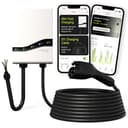
Emporia Pro EV Charger
Emporia · J1772 · 48 A / 11.5 kW · 25 ft cable
Emporia's 48-amp charger with PowerSmart load management built in: the Vue 3 energy monitor comes in the box, and the charger backs off when the rest of the house is busy. The one to look at when your panel is the obstacle.
What is good
- PowerSmart load management included, not an add-on
- Vue 3 energy monitor in the box, for whole-home data
- Emporia says it works even with older 60 or 100 amp services
- J1772 or NACS connector options
What is not
- PowerSmart needs the Vue installed in your panel -- electrician work
- Costs more than the Emporia Classic, which charges at the same 48 A
- Only worth it if your panel is the constraint
| Maximum output | 48 A hardwired; 40 A with a NEMA plug |
|---|---|
| Connector | J1772 or NACS, chosen at purchase |
| Cable | 25 ft |
| Load management | PowerSmart, standard |
| In the box | Emporia Vue 3 energy monitor |
| Installation | NEMA 14-50 plug or hardwired; rear-entry option |
| Certification | UL certified, GFCI-protected |
| Warranty | 3 years |
Skip this if: Skip it if your panel has comfortable room for a full EV circuit. Without that problem you are paying for load management you will not use -- the Emporia Classic charges at the same 48 A.
Specifications above are the manufacturer’s published figures. Source: Emporia Energy, Emporia Energy, Classic vs Pro, Emporia Energy, store. We have not tested this unit — see how we pick.
FAQ
Questions people actually ask
Is the Tesla Universal Wall Connector worth it over the Emporia Pro?
Can the Emporia Pro charge a Tesla?
Do both chargers need a 60 amp circuit?
What is PowerSmart on the Emporia Pro?
Which has the longer cable?
Which charger has the better warranty?
Sources
Where these numbers come from
- Wall Connector support page — TeslaUniversal Wall Connector: 48 A / 11.5 kW at 240 V, NACS connector with an integrated J1772 adapter in the holster, 24 ft cable, hardwired, rated for indoor and outdoor use, listed to applicable UL standards, 4-year limited warranty.
- Emporia Pro EV Charger — Emporia Energy48 A hardwired or 40 A with a NEMA 14-50 plug, 11.5 kW, J1772 or NACS chosen at purchase, 25 ft cable, PowerSmart load management included, Emporia Vue 3 energy monitor supplied in the box, rear-entry install option, UL certified and GFCI protected, 3-year warranty. Emporia says it works even with older 60 or 100 amp services.
- Emporia Classic vs. Pro EV chargers: which is right for you? — Emporia EnergyHow PowerSmart works; 48 A hardwired against 40 A with a NEMA plug; the rear-entry option. Fetched 2026-09-10.
- Electric Vehicle Charging Stations: AC Level 2 equipment — U.S. Department of Energy, Alternative Fuels Data CenterAC Level 2 adds roughly 25 miles of range per hour of charging and runs from 240 V residential or 208 V commercial service. All Tesla vehicles come with a J1772 adapter, which allows them to use non-Tesla Level 2 charging equipment. Cars sold with a native J3400 (NACS) port use that connector for all charging levels. Read 2026-10-17.
- Fuel economy of 2026 Cadillac and GMC vehicles — U.S. EPA and U.S. Department of Energy, fueleconomy.govPublished consumption ratings used in the range arithmetic here: Cadillac Lyriq 37 kWh/100 mi, GMC Sierra EV 50 kWh/100 mi, GMC Hummer EV 70 kWh/100 mi (2025). Read 2026-10-11.
- NEC Article 625: EV Charging Equipment — WireRefEV charging is a continuous load, so the branch circuit is sized at 125% of the charger's rated current -- a 48 A charger requires a 60 A circuit. Each EVSE requires a dedicated branch circuit unless an approved energy management system controls the load. Read 2026-10-17.
Read next
Related reading
- Tesla Wall Connector vs Universal Wall ConnectorTesla's two wall units: NACS-only against a built-in J1772 adapter and Powershare support.
- Emporia vs Emporia ProBoth charge at 48 A. The Pro adds load management and an energy monitor for a full panel.
- Emporia Pro vs Wallbox Pulsar PlusTwo 48 A chargers with whole-home load management, and what each needs to do it.
- Tesla Universal Wall Connector vs ChargePoint Home FlexBoth connectors in one holster against six amperage settings and a plug-in option -- and whether a Tesla charger can charge other cars.
- Load management: charging without a panel upgradeHow load management avoids a panel upgrade, what it costs in speed, and when to use it.